It really is. Even though the adult LiveJournal users have tried to educate them on their LJ user base, they still don't get it.
I have a Live Journal (actually more than one) and a Vox account, in addition to this blog and several other portals for my thoughts online. I like playing around with features to see what things can do.
And there is a reason I use Live Journal more. It is more useful. Don't get me wrong, I am fond of this little blog here, but it's rather limited in features and until recently, getting in to make a simple post required me to go through several pages until I could type in text.
The one thing I absolutely LOVE about LiveJournal is the LJ-Cut feature. This allows you to hide part of your post under a link that readers can click if they actually want to read more. Yes, I know, some of you use RSS feeds with just the first few lines displayed, so hiding large posts under a cut wouldn't make a difference to you, but that is the small view of this feature. You can also use it for punchlines, large images that may crash your low bandwidth visitors, NSFW stuff, or anything you really want people to skip over if they aren't that interested in it - like quizzes and memes.
And I like being able to read my friends journals, along with my rss feeds, on my friend list, without opening another application or going to another site. I'm not always at my computer, so it's nice to have something that is web based.
Now, does Six Apart recognize the niftyness of these features? Apparently not. Because their idea of a more adult version of LiveJournal is Vox. Where do I begin in my disappointment with Vox?
First off, comparably speaking, customizing Vox sucks. Your options are almost all pre-canned stuff. You can make some changes, but apparently as an adult you can't be trusted to add your own widgits without special help and you must abide by limits in posting book recommendations and such per post. It would seem that Six Apart believes that adult internet users are inept. And my neighborhood page is just too cluttery for reading. I am glad that they have something that tells me when there are new posts on it, because I almost never check it. I am even more grateful that my LJ doesn't have this feature because it wouldn't fit in one weekly email.
Don't get me wrong, Vox has done some improvements in the past year, but it's still more of an adult version of MySpace than LiveJournal. And I do wish I could use the autolink feature for books and albums. That is about the only thing about Vox I really am impressed with. But Vox needs something more than this to get adults to leave LiveJournal for it.
Though I still don't understand why Six Apart is so keen on trying to widen the generation gap more. Chase the regular adults away and what you get are the perverts who lie about their age. Keep us regular ones around and we can spot a fake a lot faster than some heart-broken teen. It's isolation that makes these kids vulnerable. Besides, I know families who use LJ to keep in touch with each other.
Why this little rant?
Well, today Six Apart lost power to their data center. Their first priority was their Typepad clients, which after looking at the costs for Typepad services, makes sense. Their second priority appears to be Vox, even though last I knew, there are no paid accounts for it.
I have a paid LiveJournal account. Even those account that aren't paid generate some revenue since they've added ads to them. So, why is Live Journal the last system they are trying to get up?
Because Six Apart in their ignorant snobbery assumes that LiveJournal users aren't as important. Even though many journals show competency in designing their own cascading style sheets, they think that geeks want to pay an arm and a leg for a blog or just have bare bores and adults want limited features. So LiveJournal users aren't worth their effort.
Someone need to get their head out of the sand. This ain't Logan's Run, people. Even not counting the middle-aged people like me on there, the teenagers have to grow up. Are we seriously expecting them to leave enmass to Facebook when they turn 18? And then go on to another product? Why this ageism?
I swear people are so stupid at times...
Tuesday, July 24, 2007


Thursday, May 24, 2007
Video Playlist of the Domestic Tension project
I wanted to set the videos up so one can watch how things progress from beginning to end.
Playlist: Wafaa Bilal's Paintball project
wafaabilal.com
Iraqi born artist Wafaa Bilal has become known for provocative interactive video installations. Many of Bilal's projects over the past few years have addressed the dichotomy of the virtual vs. the real. In Domestic Tension, viewers can log onto the internet to contact, or shoot, Bilal with paintball guns.
Playlist: Wafaa Bilal's Paintball project
wafaabilal.com
Iraqi born artist Wafaa Bilal has become known for provocative interactive video installations. Many of Bilal's projects over the past few years have addressed the dichotomy of the virtual vs. the real. In Domestic Tension, viewers can log onto the internet to contact, or shoot, Bilal with paintball guns.
Saturday, May 19, 2007
Domestic Tension
A performance art/experiment by Wafaa Bilal
But before you participate, you might want to check out the following first:
Interview with Wafaa Bilal - Lessons about dehumanization and technology from a man living under the gun
http://www.crudeoils.us/
http://www.youtube.com/watch?v=5AkwY9g-iDA
And the rest at http://www.youtube.com/profile?user=mewafaa
But before you participate, you might want to check out the following first:
Interview with Wafaa Bilal - Lessons about dehumanization and technology from a man living under the gun
http://www.crudeoils.us/
http://www.youtube.com/watch?v=5AkwY9g-iDA
And the rest at http://www.youtube.com/profile?user=mewafaa
Monday, April 09, 2007
Essay for Arts and Human Values
Thomas Moran’s The Lava Flows has always been my favorite piece of the permanent collection at the Oklahoma City Art Museum. This approximately 18 by 24 inch, oil on panel painting was done in 1889, as an illustration of the lava flows on Mount Etna for the Scribner’s children’s magazine St. Nicholas. The white glowing lava flows down the pitch black mountain and around jagged black rocks, unifying the painting in a river of light. It is a visually powerful piece, full of energy, despite its black and white color scheme, due to its high contrast and the motif of irregular, triangular shapes. Its main focal point is at lower left, third by third division point, and consists of a triad of triangular rock formations, creating another triangular unity through their proximity and similarities in form. Combining the triadic groups, with thirds placements and triangular forms gives a firm grounding to the jagged lines and other irregularities back lit by the glowing lava. It is to my great disappointment that prints are not available of this striking painting. While earlier issues of St. Nicholas magazine are available online through Project Gutenberg, the 1889 issues have yet to be added.
Viewing other examples of Moran’s works, it becomes obvious that this is an atypical piece for him for various reasons. First, it is not of an American landscape, but an European location, a slight departure of subject matter for a painter who was hailed as the “dean of American landscape painters” and “father of the National Parks”. Though Moran was well-traveled and did do the occasional painting of old world scenes, the main focus of his works was the New World his father emigrated to from Great Britain when Thomas was still a boy. However, considering that St. Nicholas was a magazine that aspired to bring the best of culture and knowledge to American children, it is quite understandable why Moran would agree to paint for it. Second, it is done in stark black and white, instead of the realistic colors of his other nature pieces. Other artists who show his ability with colors, often have difficulty bringing the same intensity and clarity into a monochromatic format. Third, it is more claustrophobic in its focus, unlike the panoramic views of the American West that Thomas Moran is more famous for.
The piece in its atypical nature is an excellent example of just how talented Moran was as an artist. His use of contrasting values demonstrated a deep understanding of printed works, probably developed from his early years as a wood engraver’s apprentice. The placement of his focal point and use of unifying factors exemplified one who was well-schooled in formal design and composition, which he likely learned from his elder brother, Edward Moran, a well-known marine painter, and other artists such as J. M. W. Turner. While others would probably prefer his masterpieces of Yellowstone and the Grand Canyon on display at the U.S. Capitol, I think this little painting is just as worthy of admiration.
Viewing other examples of Moran’s works, it becomes obvious that this is an atypical piece for him for various reasons. First, it is not of an American landscape, but an European location, a slight departure of subject matter for a painter who was hailed as the “dean of American landscape painters” and “father of the National Parks”. Though Moran was well-traveled and did do the occasional painting of old world scenes, the main focus of his works was the New World his father emigrated to from Great Britain when Thomas was still a boy. However, considering that St. Nicholas was a magazine that aspired to bring the best of culture and knowledge to American children, it is quite understandable why Moran would agree to paint for it. Second, it is done in stark black and white, instead of the realistic colors of his other nature pieces. Other artists who show his ability with colors, often have difficulty bringing the same intensity and clarity into a monochromatic format. Third, it is more claustrophobic in its focus, unlike the panoramic views of the American West that Thomas Moran is more famous for.
The piece in its atypical nature is an excellent example of just how talented Moran was as an artist. His use of contrasting values demonstrated a deep understanding of printed works, probably developed from his early years as a wood engraver’s apprentice. The placement of his focal point and use of unifying factors exemplified one who was well-schooled in formal design and composition, which he likely learned from his elder brother, Edward Moran, a well-known marine painter, and other artists such as J. M. W. Turner. While others would probably prefer his masterpieces of Yellowstone and the Grand Canyon on display at the U.S. Capitol, I think this little painting is just as worthy of admiration.
Monday, March 26, 2007
Possible research for a psych paperhttp://www.post-gazette.com/ae/20010930artprison0930fnp2.asp
If not art, then what?
Sunday, September 30, 2001
By Tim Menees, Post-Gazette Editorial Cartoonist
Post-Gazette cartoonist Tim Menees spent several days inside penitentiaries in Pennsylvania, California and New York, three states that provide arts programs for their inmates. Today, Menees focuses on prisoners' art and writing. In the Daily Magazine on Tuesday, he brings us music and theater.
Murderabilia
Fascination with serial killers is an American pastime, spurring a profitable underground trade. Some people are so obsessed with the subject that they carry on correspondence with men behind bars, design trading cards or board games, or indulge in a more expensive hobby: purchasing art made by killers or depicting their murders. Several collectors have expressed the idea that having something a murderer made protects them in some way.
Effects of art therapy with prison inmates: A follow-up study
David Gussak, Ph.D., ATR-BC
Sunday, September 30, 2001
By Tim Menees, Post-Gazette Editorial Cartoonist
Post-Gazette cartoonist Tim Menees spent several days inside penitentiaries in Pennsylvania, California and New York, three states that provide arts programs for their inmates. Today, Menees focuses on prisoners' art and writing. In the Daily Magazine on Tuesday, he brings us music and theater.
Murderabilia
Fascination with serial killers is an American pastime, spurring a profitable underground trade. Some people are so obsessed with the subject that they carry on correspondence with men behind bars, design trading cards or board games, or indulge in a more expensive hobby: purchasing art made by killers or depicting their murders. Several collectors have expressed the idea that having something a murderer made protects them in some way.
Effects of art therapy with prison inmates: A follow-up study
David Gussak, Ph.D., ATR-BC
Wednesday, February 07, 2007
Artist report for my Arts and Human Values Class
Antony Gormley
Arts and Human Values
British artist and sculptor Antony Gormley was born August 30th, 1950, as the youngest of seven children, to prosperous family in Hampstead, England. Gormley studied at Ampleforth College; Trinity College, Cambridge; and various other colleges in London, before completing his education with a postgraduate course in sculpture at the Slade School of Art. In the middle of his artistic education, he spent five years in India and Sri Lanka to study Buddhism. In 1994, Gormley won the Turner Prize with Field for the British Isles. He is currently a trustee of the Baltic Centre for Contemporary Art.
Though he has been known to work in several media, (such as terra cotta, wood, and bread and wax) Gormley is mainly known for using metal castings of his own body. According to radio interviews with the BBC, Gormley prefers to actually be a part of his work materials while creating his pieces, to truly feel the experience he is trying to inspire. His casts are done with the help of his wife and a workman. He is first covered in cling wrap (i.e. plastic wrap), which provides a better barrier between him and the plaster than Vaseline does. Then his wife applies the plaster and after it dries, she cuts him out of the mold. Then fibreglass and metal (usually lead) is used to create the figures. Gormley feels the skin-like nature of his sculptures is so important that he will often list "air" as a material used.
Gormley is known for making the setting part of his works. In Total Strangers (1997), his metal figures are placed not only in the museum, but outside as well, with one figure looking at another through a window. In Land, Sea and Air II (1982), he has three figures in various positions on a beach, contemplating the elements. Scuplture for Derry Walls (1987) has three sets of double figures, standing back to back, one always facing towards the Catholic regions of Ireland, while the other faces the Protestant regions. Each figure gives the impression of setting a boundary and blocking the way. A piece I find most intriguing is Learning to Think (1991), which shows five figures hanging from the ceiling as if their heads were above it. Better know works of Gormley include his Field series, Iron: Man (1993), Another Place (1997) and Angel of the North (1998). An apparently lesser known piece is the Oslo Holocaust Memorial (2000), where he forgoes his normal penchant for human forms and has six empty chairs instead.
Antony Gormley firmly believes that art is meant to be a universal experience and not just something for people with disposable income. Art has the potential to connect people to the real world and themselves. The redemptive qualities of art cannot fully be realized in specialized settings such as an art gallery or museum or other refined spaces. Art galleries have an important part in the art world, however they should not be the final goal, but as a means to get art into the real world, where it can work on the souls of everyone.
[side note: you can find the works mentioned if you go to Antony Gormley's main site and click on "walk through".]
Tuesday, December 12, 2006
Geek Nirvana
As of today, I have become the answer to the Ultimate Question of Life, the Universe and everything. My baby sister even gave me a towel to celebrate.
Saturday, November 04, 2006
Common traits of creative people and a few words about intelligence
According to Csikszentmihalyi (1997):
Number four is something I've noticed a lot. So many people who live unconventional lives are so limited in true creativeness in problem solving and in understanding views different than their own in an objective manner. Yes, they do things different that the "mainstream", but they imitate each other rather faithfully and appear more threatened by those who variate from their variation. This goes for extreme "fundamentalists" as much as it goes for radical "alternatives". Neither group is actually living a conventional lifestyle. When all is said and done, both are trying desperately to set themselves about from the common person.
I think for the deliberate unconventionalist, it's a matter of trying too hard. They are so frantically trying to be "different" that they do not take the mental space and time to actually let their mind give "birth" to new concepts and ideas in a natural manner. And they are so afraid of being "normal" that they don't have the courage to walk down an accepted path to see if there may be something useful there that can be modified into something worthwhile.
I realize that I haven't really been posting from my studies here as I usually do. Some of it is a lack of time. Some of it is that I am taking studio classes and reviewing other material. And I've been posting my Art History notes on my VOX account because of certain features there. (Though I won't truly be happy with VOX until they offer full HTML support, but since it was designed for the less programming literate user, it's probably not going to happen. However, it's great for reviewing books, movies and music. If you want an invite, feel free to contact me for one.)
Anyway, I'm reviewing topics in psychology, which has been nice, since I am getting a broader overview to things I learned more in-depth before. This morning I read the section on IQ testing and again I am still extremely amused how some people cling to their IQ scores without having any real understanding of what they actually mean or represent, much less any knowledge of what the studies have shown on the subject. High IQs only predict academic success - NOT REAL INTELLIGENCE. In other words, they only predict how well you can function in this culture's educational system. It was originally meant to help identify people who needed extra help in learning in a normal school setting.
Psychologist have found that people showing high levels of practical intelligence tend to function very badly in academia. However, that doesn't mean that practical intelligence guarantees a happy and successful life either. The single most common element for those who live a full and successful life is a consistent sense of self.
- Creative people usually have a broad range of knowledge about a lot of subjects and are good at using mental imagery.
- Creative people aren't afraid to be different -- they are more open to new experiences than many people, and they tend to have more vivid dreams and daydreams than others do.
- Creative people value their independence.
- Creative people are often unconventional in their work, but not otherwise.
Number four is something I've noticed a lot. So many people who live unconventional lives are so limited in true creativeness in problem solving and in understanding views different than their own in an objective manner. Yes, they do things different that the "mainstream", but they imitate each other rather faithfully and appear more threatened by those who variate from their variation. This goes for extreme "fundamentalists" as much as it goes for radical "alternatives". Neither group is actually living a conventional lifestyle. When all is said and done, both are trying desperately to set themselves about from the common person.
I think for the deliberate unconventionalist, it's a matter of trying too hard. They are so frantically trying to be "different" that they do not take the mental space and time to actually let their mind give "birth" to new concepts and ideas in a natural manner. And they are so afraid of being "normal" that they don't have the courage to walk down an accepted path to see if there may be something useful there that can be modified into something worthwhile.
I realize that I haven't really been posting from my studies here as I usually do. Some of it is a lack of time. Some of it is that I am taking studio classes and reviewing other material. And I've been posting my Art History notes on my VOX account because of certain features there. (Though I won't truly be happy with VOX until they offer full HTML support, but since it was designed for the less programming literate user, it's probably not going to happen. However, it's great for reviewing books, movies and music. If you want an invite, feel free to contact me for one.)
Anyway, I'm reviewing topics in psychology, which has been nice, since I am getting a broader overview to things I learned more in-depth before. This morning I read the section on IQ testing and again I am still extremely amused how some people cling to their IQ scores without having any real understanding of what they actually mean or represent, much less any knowledge of what the studies have shown on the subject. High IQs only predict academic success - NOT REAL INTELLIGENCE. In other words, they only predict how well you can function in this culture's educational system. It was originally meant to help identify people who needed extra help in learning in a normal school setting.
Psychologist have found that people showing high levels of practical intelligence tend to function very badly in academia. However, that doesn't mean that practical intelligence guarantees a happy and successful life either. The single most common element for those who live a full and successful life is a consistent sense of self.
Saturday, October 28, 2006
For blogging critics
Most bloggers are just want-to-be amatuer editorialists, who want to influence the public.
While I agree there are several blogs like this, most bloggers only occasionally embark on social commentary and usually it's just to get it off their chest. Like myself, they know that maybe a few or dozen people read their stuff and that most of them are either friends and/or the choir (as in "preaching to the choir"). Most of us do not expect our writings to be the key to social change. We're just expressing ourselves, like countless humans before us. The only difference is instead of doing it over a fence or in a barber shop or bar, we're doing it from the comfort of our own homes.
People post a lot of stupid, boring things no one else cares about.
Ego problem much? And where do you get off having the idea that everything on the Internet is supposed to cater to you and your needs? A lot of us who put up those "stupid, boring things" honestly don't want your readership. We're putting it up for our friends and family and for our own records and/or self-expression - and this is an easy way to do it. Don't like it - go back to playing World of Warcraft.
Everything looks the same.
Of course you're going to find a lot of similar stuff. We're all humans and have many similar needs and all that nonsense. You want mental stimulation, go to a library. They have these things there called "books" that are cleverly organized for locating interesting subjects with ease. Remember, the Dewey Decimal System is your friend. Learn its ways and the Universe is yours. If you want more mental stimulation, then enroll yourself into a class of something you've never studied before. If you want more than that, then you need to get off your tush and learn how to do valid reseach and start discovering your own stuff. Only you can exercise your mind.
You want emotional stimulation, go out and meet people. Better yet, become a volunteer. At the very least, call your relatives.
Cross-posted from my LiveJournal. Decided it was worth repeating.
Saturday, October 21, 2006
Restraint Asphyxiation
While training in the Mandt System for work, I was introduced to a phenomenom of restraint asphyxiation where an increase of neuro-transmitters known as catecholamines can lead to a heart attack anytime upto 24 hours after being restrained.
One of the sources quote was Restraint Asphyxia - Silent Killer by Charly D. Miller, Paramedic EMS Author & Educator, and Consultant Restraint Asphyxia Expert Witness. I find all the text emphasizing more than a little distracting. So here is the section, I wish to concentrate on:
The Canadian Journal of Psychiatry June 2003 has this article on the subject. The following snippet talks about Catecholamine Rush:
Another article has information on it, but I would have to subscribe to read it:
Weight Force During Prone Restraint and Respiratory Function.
American Journal of Forensic Medicine & Pathology. 25(3):185-189, September 2004.Chan, Theodore C. MD *; Neuman, Tom MD *+; Clausen, Jack MD +; Eisele, John MD ++; Vilke, Gary M. MD *
Actually there are several other articles similarly protected.
Researching "Catecholamine Rush", I found a nice little article on the Science Blog, reprinted from Columbia University College of Physicians and Surgeons:
One of the sources quote was Restraint Asphyxia - Silent Killer by Charly D. Miller, Paramedic EMS Author & Educator, and Consultant Restraint Asphyxia Expert Witness. I find all the text emphasizing more than a little distracting. So here is the section, I wish to concentrate on:
States of extreme emotional- and physical-exertion also generate excessive
production of several other naturallyproduced body chemicals; especially the
chemicals released by the "Fight/Flight" nervous system, such as adrenalin and
noradrenalin. Medical professionals call these naturally-produced "Fight/Flight"
chemicals, "catecholamines." During all of the emotionally- and
physicallyexertive activities that precede and are associated with restraint
asphyxia deaths, progressively-increasing amounts of catecholamines are released
into the Victim's system.
This creates what medical professionals call a, "hypercatabolic state" – an
"overdose" of these naturally-produced chemicals. A hypercatabolic state is a
chemical imbalance that weakens ALL of the body's muscles. But, it especially
weakens the respiratory muscles.(1,12)
A hypercatabolic state also adversely effects the HEART.(1,12)
Catecholamines cause the heart to contract (beat) faster, and with greater FORCE of contraction – exerting greater "effort" to work. Since the heart is a muscle that (like the respiratory muscles) is entirely unaccustomed to having to work terrifically hard for a prolonged period of time, the heart rapidly becomes exhausted when required to work harder than it is used to working. Furthermore; to work FASTER and more FORCEFULLY, the heart muscle requires more SUGAR and OXYGEN to fuel an increased functional performance demand.But, when struggling against Restrainers, the Victim's extremity muscles are using up the vast majority of the body's sugar stores. So, less and less sugar is available to fuel the heart's function. AND, when struggling against Restrainers, the Victim's heart requires greater than "normal" amounts of oxygen to support the increased workload that is demanded of it. BUT, if the Victim is struggling against Restrainers who are employing a form of restraint that MAKES BREATHING DIFFICULT (such as forceful-prone-restraint), his heart receives far less than normal amounts of oxygen.(1,17,26-28,40)
The Canadian Journal of Psychiatry June 2003 has this article on the subject. The following snippet talks about Catecholamine Rush:
Massive release of adrenal catecholamines may occur in patients who are involved
in escalating agitation, struggles with staff members, and “takedowns” to the
ground or who are carried elsewhere and secured with restraints. This
catecholamine outpouring may sensitize the heart and produce rhythm disturbances
(23). Behavioural arousal and psychological stress have been shown to induce
malignant cardiac rhythm disturbances (23–25).
Neural and psychological factors have been implicated as risk factors for ventricular arrhythmias and sudden death (24–26). Neural integration of body functions takes place through a complex system of feedback loops when information from within and without the organism is taken in and catalogued by the brain. These pathways play a major role in causing sudden death in persons who find themselves in perilous
situations. Moreover, the situations need not be perilous to precipitate cardiac
arrhythmias (26). Lown and colleagues identified psychic stress as a mediating
factor for advanced cardiac arrhythmias, and it has been suggested that
emotional extremes are triggering mechanisms for sudden cardiac death (24–26).
Deaths associated with extreme physiological exertion differ somewhat.
Emergency medicine physicians recently reported cases of profound metabolic
acidosis in cardiac arrest associated with use of restraints. In a sample of
patients who died—most, but not all of whom had been under the influence of
cocaine—the recorded blood pH was 6.25. The common variable was extreme exertion from either fleeing or fighting vigorously while being subdued. The authors
speculate that psychosis and delirium, including drug-induced delirium, alter
pain sensation and may thus render patients capable of exertion far beyond their
normal capacity, leading to maximal sympathetic discharge and catecholamine
depletion (27). By provoking further struggle, physical restraint results in
overwhelming acidosis. Acidosis of this magnitude should trigger physiologic
compensatory mechanisms, but the prone restraint position may limit reflex
compensation (27).
Another article has information on it, but I would have to subscribe to read it:
Weight Force During Prone Restraint and Respiratory Function.
American Journal of Forensic Medicine & Pathology. 25(3):185-189, September 2004.Chan, Theodore C. MD *; Neuman, Tom MD *+; Clausen, Jack MD +; Eisele, John MD ++; Vilke, Gary M. MD *
Actually there are several other articles similarly protected.
Researching "Catecholamine Rush", I found a nice little article on the Science Blog, reprinted from Columbia University College of Physicians and Surgeons:
The more calcium that the ryanodine receptor releases, the stronger the
contraction of the heart. Dr. Marks and his colleagues have discovered that
increased levels of catecholamines, chemicals such as adrenaline that help
transmit nerve impulses, can trigger the ryanodine receptor to release more
calcium.
Patients with heart failure have high levels of catecholamines in
their blood, but their calcium ion release system does not respond properly to
these neurotransmitters. This causes the nervous system to release even more
catecholamines, with little or no response from the heart muscle. Dr. Marks
discovered that a malfunctioning ryanodine receptor is the weak link in the
calcium channel release system that causes this failure in catecholamine
response.
Monday, September 25, 2006
URLs for a class article on the Anniversary Effect
Decided to go ahead and post them here before my son rearranges things on the computer.
http://www.ncptsd.va.gov/facts/disasters/fs_anniversary.html
http://mentalhelp.net/poc/view_doc.php?type=doc&id=9222&cn=109
It appears that everything else I've been looking at is quoting the same articles as these two sites.
From the first article:
http://www.ncptsd.va.gov/facts/disasters/fs_anniversary.html
http://mentalhelp.net/poc/view_doc.php?type=doc&id=9222&cn=109
It appears that everything else I've been looking at is quoting the same articles as these two sites.
From the first article:
Are there any empirical studies of anniversary
reactions?
There are few empirical studies of anniversary reactions. In one study, 92 widows and widowers were interviewed on the first anniversary of their spouse's death. Four of the participants reported clinically significant depression that they connected to the anniversary date (Borstein & Clayton, 1972). In a series of studies, Morgan and colleagues examined anniversary reactions in Gulf War veterans two and six years after the end of the Gulf War (Morgan, Hill, Fox, Kingham, & Southwick, 1999; Morgan, Kingham, Nicolaou, & Southwick, 1998). The researchers asked the veterans and their wives to identify the veteran’s worst month of functioning in the past year. When the researchers compared the worst month identified to previously identified dates of traumatic events that occurred during the Gulf War, they found that 38% of participants reported that their worst month coincided with the month in which their trauma occurred (Morgan et al., 1999). Veterans with these anniversary reactions had significantly more PTSD symptoms than veterans who did not have anniversary reactions, and all of the veterans who met criteria for a diagnosis of PTSD had anniversary reactions (Morgan et al, 1999). Finally, one study was done examining patterns of hospital admissions in patients with seasonal mood disorders (Beratis, Gourzis, & Gabriel, 1996). Based on chart reviews, 4 out of 41 patients with multiple hospital admissions over a seven-year period exhibited depressive or manic episodes that coincided with the time of a past traumatic event.
Now here are more unique links:
http://incestabuse.about.com/od/emotions/a/anniversaries.htm
http://www.postgradmed.com/issues/2001/11_01/pn_stress.htm
http://www.nmha.org/reassurance/ptsd.cfm
http://www.coolnurse.com/anxiety_ptsd.htm
http://www.nyas.org/ebriefreps/main.asp?intSubsectionID=2854
http://www.webmd.com/content/article/60/67146
http://www.trauma-pages.com/vanderk4.htm ==>Actually, this page is no long available, so I am going to use the archived version. Someone shared this page with me about four years ago and it is far too good to lose track of.
Monday, September 11, 2006
Five years ago...
I was working as a temporary clerk in an HR office for a contractor on Tinker AFB. It was a short term assignment - I was just helping them get caught up on some paperwork. The head HR person boarded a plane for a business meeting back east.
I was sorting papers when someone came in and said that a plane had hit one of the World Trade Centers. There were speculations about pilot error and equipment problems. I called my dad to see if he had heard about it. He telecommutes from home and often watches the news in the morning as he's working. Only this morning he had something he needed to fully concentrate on, so my call was the first time he heard about it. I didn't want to take too much time, so I told him to check out the news and went back to my papers.
There was a TV in one section of the building. I decided to take a break a few minutes later and watch the news footage for a few moments. After all, we were on an Airforce base, plane crashes were something we took an interest in. I was standing there, listening to the discussion, when the second tower was hit. The temperature of the room dropped as we all realized that this was not an accident. An older guy said it was China. I said it couldn't be. China wasn't that stupid. They knew what we were capable of doing and would never just do an attack to annoy us. They would have picked military strategic targets to keep us from retaliating. I was rather surprised at myself for speaking up like that in a place I hadn't worked even two weeks at and wasn't planning to work much longer at. But my mind was trying to process what the news was showing us.
We talked about the fact that Tinker was number Three on the strategic hit list because that's where the AWACs are stationed, but it didn't really hit us that we could be a target until the Pentagon was attacked. Then, as they say, it became personal. First we made sure the few people we had flying on business were okay and accounted for - as well as family members. After we had some idea about our loved ones, a sort of determined numbness became apparant. A lot of us decided that if we were going to go, then we were going to go down doing our jobs and supporting those who were going to fight these people. But even saying that, many of us were looking at out the windows, as if any moment another plane was going to come straight at us.
I was pretty much okay until I left the air force base, despite expecting another attack. I suddenly felt so helpless and vulnerable as I drove off base. On base, I was part of the fight, even if all I was doing was making sure the paperwork for our reservist personnel was in order and helping them to understand what their insurance would cover if their units were reactivated and called into battle. Off base, I was just a civilian target. I was angry that all the gas stations had hiked up their prices bacause I was so low on gas. But I was able to nurse it until the next morning when I could fill up at a station that had gotten the Governor's message through its head. I had to go to the temp office to pick up my paycheck. The receptionist said, "You're working at Tinker, aren't you? Are you okay?" I shook my head and bit back the tears - and then told her I felt better on base than off. Which probably explains why I was willing to wait five and a half hours to get back on the next day. The security checks were a real pain in the neck. They looked everywhere in our vehicles before letting them on base.
The other HR person I was working with handled the whole thing rather badly. She wanted everyone to stop talking about the tragedy, but she only said it to me, because I wasn't in a position to call her on it. She even said, "If you don't talk about it, it can't hurt you." Which is probably one of the most ignorant and delusional statements I have ever heard from someone, but I didn't challenge her on it. I just held my tongue as she kept snapping at me for stupid stuff, until I was starting to fantasize about strangling her. Didn't affect her, my foot. She acted worse than everyone else in the building. Denial can help in a crisis, but too much of any thing is bad. And her denial fell into that category. Her tactic of denying the attack took place couldn't hold up when part of her job was now dealing with the reality of working on an Airforce base during a time of national crisis. And as a result, she was the most messed up of everyone.
The rest of the time I worked there, until my assignment was ended, I would stare at the two watertowers near us because when the head of HR came back, she told me how she wished they would paint over the base name on them. She felt it called too much attention to the base. I'm sure that she realized on one level she was being a bit ridiculous - as did I. However, that didn't keep me from trying to calculate the damage that would happen if one of those watertowers did get hit.
I thought I had written this summary up before, but I'm not sure where I saved it. So I figured I would repost it today. A friend found a site with audio recording of people's memories of that event. My speakers aren't hooked up right now, so I'll listen to them later. A good article to read is Healing from trauma may be swiftest when it's not all about you.
I didn't listen to any of the in-depth details of the attacks until a year later, because I sensed that my family wasn't ready for it. But on the first anniversary, I needed more facts. I had been polite long enough and I needed to satisfy my curiosity and verify the theories I had. My mother actually got snippy at me when I started this search, but I told her that I had been respecting their feelings and now I had to take care of my own emotional need to know the truth. It wasn't like I was forcing anyone else to join me.
I got the factual details back then. Until this year, I haven't really tried to learn about the victims themselves, because I didn't want to be accused of being morbidly obsessed. But really this is necessary and a healthy thing to do. What's more, it's the right thing to do. 2996 PEOPLE died then - because they had been made into symbolic objects. If I don't want to be a part of that problem, then I need to acknowledge the PEOPLE and not the collective.
I was sorting papers when someone came in and said that a plane had hit one of the World Trade Centers. There were speculations about pilot error and equipment problems. I called my dad to see if he had heard about it. He telecommutes from home and often watches the news in the morning as he's working. Only this morning he had something he needed to fully concentrate on, so my call was the first time he heard about it. I didn't want to take too much time, so I told him to check out the news and went back to my papers.
There was a TV in one section of the building. I decided to take a break a few minutes later and watch the news footage for a few moments. After all, we were on an Airforce base, plane crashes were something we took an interest in. I was standing there, listening to the discussion, when the second tower was hit. The temperature of the room dropped as we all realized that this was not an accident. An older guy said it was China. I said it couldn't be. China wasn't that stupid. They knew what we were capable of doing and would never just do an attack to annoy us. They would have picked military strategic targets to keep us from retaliating. I was rather surprised at myself for speaking up like that in a place I hadn't worked even two weeks at and wasn't planning to work much longer at. But my mind was trying to process what the news was showing us.
We talked about the fact that Tinker was number Three on the strategic hit list because that's where the AWACs are stationed, but it didn't really hit us that we could be a target until the Pentagon was attacked. Then, as they say, it became personal. First we made sure the few people we had flying on business were okay and accounted for - as well as family members. After we had some idea about our loved ones, a sort of determined numbness became apparant. A lot of us decided that if we were going to go, then we were going to go down doing our jobs and supporting those who were going to fight these people. But even saying that, many of us were looking at out the windows, as if any moment another plane was going to come straight at us.
I was pretty much okay until I left the air force base, despite expecting another attack. I suddenly felt so helpless and vulnerable as I drove off base. On base, I was part of the fight, even if all I was doing was making sure the paperwork for our reservist personnel was in order and helping them to understand what their insurance would cover if their units were reactivated and called into battle. Off base, I was just a civilian target. I was angry that all the gas stations had hiked up their prices bacause I was so low on gas. But I was able to nurse it until the next morning when I could fill up at a station that had gotten the Governor's message through its head. I had to go to the temp office to pick up my paycheck. The receptionist said, "You're working at Tinker, aren't you? Are you okay?" I shook my head and bit back the tears - and then told her I felt better on base than off. Which probably explains why I was willing to wait five and a half hours to get back on the next day. The security checks were a real pain in the neck. They looked everywhere in our vehicles before letting them on base.
The other HR person I was working with handled the whole thing rather badly. She wanted everyone to stop talking about the tragedy, but she only said it to me, because I wasn't in a position to call her on it. She even said, "If you don't talk about it, it can't hurt you." Which is probably one of the most ignorant and delusional statements I have ever heard from someone, but I didn't challenge her on it. I just held my tongue as she kept snapping at me for stupid stuff, until I was starting to fantasize about strangling her. Didn't affect her, my foot. She acted worse than everyone else in the building. Denial can help in a crisis, but too much of any thing is bad. And her denial fell into that category. Her tactic of denying the attack took place couldn't hold up when part of her job was now dealing with the reality of working on an Airforce base during a time of national crisis. And as a result, she was the most messed up of everyone.
The rest of the time I worked there, until my assignment was ended, I would stare at the two watertowers near us because when the head of HR came back, she told me how she wished they would paint over the base name on them. She felt it called too much attention to the base. I'm sure that she realized on one level she was being a bit ridiculous - as did I. However, that didn't keep me from trying to calculate the damage that would happen if one of those watertowers did get hit.
I thought I had written this summary up before, but I'm not sure where I saved it. So I figured I would repost it today. A friend found a site with audio recording of people's memories of that event. My speakers aren't hooked up right now, so I'll listen to them later. A good article to read is Healing from trauma may be swiftest when it's not all about you.
I didn't listen to any of the in-depth details of the attacks until a year later, because I sensed that my family wasn't ready for it. But on the first anniversary, I needed more facts. I had been polite long enough and I needed to satisfy my curiosity and verify the theories I had. My mother actually got snippy at me when I started this search, but I told her that I had been respecting their feelings and now I had to take care of my own emotional need to know the truth. It wasn't like I was forcing anyone else to join me.
I got the factual details back then. Until this year, I haven't really tried to learn about the victims themselves, because I didn't want to be accused of being morbidly obsessed. But really this is necessary and a healthy thing to do. What's more, it's the right thing to do. 2996 PEOPLE died then - because they had been made into symbolic objects. If I don't want to be a part of that problem, then I need to acknowledge the PEOPLE and not the collective.
Wednesday, September 06, 2006
9/11 Tribute - Richard G. Catarelli
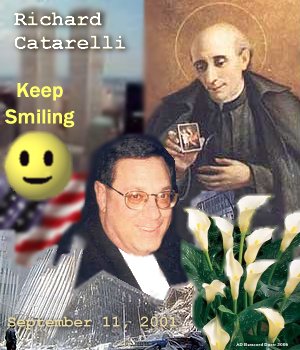
Richard G. Catarelli, employee of Marsh & McLennan, was a man of great faith and compassion. Prior to September 11th, 2001, he and his daughter Anamarie had just completed training to be youth ministers as a reflection of his devotion and dedication to the youth of the community. A cheerful and loving person, Richard's favorite line was "Keep Smiling" and his role model was the generous and energetic St. Vincent Pallotti.
Marsh and McLennan Companies has a very moving tribute page in his honor, with tributes from his wife and others close to him. It says more about this man than anything a random blogger like myself could ever say.
Other links about Richard:
http://www.september11victims.com/September11victims/VictimInfo.asp?ID=688
http://www.unitedinmemory.net/quilt.php?quilt=469
http://www.legacy.com/Guestbook.asp?PersonID=108361
Please read some of the other tributes written by the Bloggers for 2996.
(and if that isn't working, go here)

Wednesday, August 23, 2006
2,996: A Tribute to the Victims of 9/11
2,996 is a tribute to the victims of 9/11.
On September 11, 2006, 2,996 volunteer bloggers
will join together for a tribute to the victims of 9/11.
Each person will pay tribute to a single victim.
We will honor them by remembering their lives,
and not by remembering their murderers.
My person is Richard G. Catarelli, age 47.
Place killed: World Trade Center. Resident of New York, N.Y. (USA).
His tribute will be here on September 11, 2006.
If you have any questions about this project, you can probably find the answers here.
Friday, July 28, 2006

Friday, July 21, 2006
LJ Feed Button

I actually made this for another feed.
I've been balancing my information from Cedarseed and Israel North blog. I've been occassionally checking other sources, but these two have been the most useful.
Wednesday, July 05, 2006
Monday, June 26, 2006
The World eBook Fair
http://www.worldebookfair.com/
The World eBook Fair welcomes you to absolutely free access to a variety of eBook unparalleled by any other source. 1/3 million eBooks await you, all free of charge for the month from July 4 - August 4, 2006, and then 1/2 million eBooks in 2007, 3/4 million in 2008, and ONE million in 2009.
The World eBook Fair welcomes you to absolutely free access to a variety of eBook unparalleled by any other source. 1/3 million eBooks await you, all free of charge for the month from July 4 - August 4, 2006, and then 1/2 million eBooks in 2007, 3/4 million in 2008, and ONE million in 2009.
Friday, June 09, 2006
Some very informative sites
School Art Therapy
Excellent site for information on using art therapy in schools.
When Death Nears...
Pretty much the same information I have in my hospice volunteer documentation. At least in the pamphlet we give the families. I actually have more medical/technical handouts about it too.
Excellent site for information on using art therapy in schools.
When Death Nears...
Pretty much the same information I have in my hospice volunteer documentation. At least in the pamphlet we give the families. I actually have more medical/technical handouts about it too.
Tuesday, May 16, 2006
quick update
Finally walked for my BS in FSG last Saturday. Am still waiting to hear how much financial aide I will be getting for the art classes. Yes, I am going to get an associates in visual arts because it allows me to get funding and after I take all I need for my masters, I will have met the requirements anyway.
Saturday, April 29, 2006
A website I plan to revisit
Viktor Frankl Institute
Viktor E. Frankl, M.D., Ph.D.
Neurologist and psychiatrist
Founder of Logotherapy and Existential Analysis
During World War II he spent 3 years at Auschwitz, Dachau and other concentration camps.
(I've known about this guy since I was in high school. I just haven't studied him as much as I would like.)
Viktor E. Frankl, M.D., Ph.D.
Neurologist and psychiatrist
Founder of Logotherapy and Existential Analysis
During World War II he spent 3 years at Auschwitz, Dachau and other concentration camps.
(I've known about this guy since I was in high school. I just haven't studied him as much as I would like.)
Wednesday, March 29, 2006
Long time - no post
I hadn't realized it had been almost two months since my last post here. I apologize for the choppiness. I am very tired right now. Anyway, the state of my career/education at the moment.
Before I can apply for the masters program I want, I need to get some college level art classes. Most of my art knowledge was either received as a kid or self-taught. I will start at a community college this summer and if all goes well, I will have all my art credit done in two semesters.
In the meantime, I am working as a substitute teacher for the school district I live in. So far I've done Special Ed and elementary jobs. I actually like working with the special ed kids more. First off, they're not as sneaky. Second, the expectations are lower, so you can relax more and tend to their needs better. I took only a half day assignment today because I really am tired.
I am also a bereavement volunteer for a private hospice. I'm still in training for the volunteer program, but will be doing a regular volunteer assignment on Friday, since they were short people. I have completed the normal volunteer training and now need to schedule the bereavement training. I will be doing things like attending wakes, funerals, and memorials, as well as help plan them in some instances. But for the most part, I will just be checking in on survivors and just listening to them.
Before I can apply for the masters program I want, I need to get some college level art classes. Most of my art knowledge was either received as a kid or self-taught. I will start at a community college this summer and if all goes well, I will have all my art credit done in two semesters.
In the meantime, I am working as a substitute teacher for the school district I live in. So far I've done Special Ed and elementary jobs. I actually like working with the special ed kids more. First off, they're not as sneaky. Second, the expectations are lower, so you can relax more and tend to their needs better. I took only a half day assignment today because I really am tired.
I am also a bereavement volunteer for a private hospice. I'm still in training for the volunteer program, but will be doing a regular volunteer assignment on Friday, since they were short people. I have completed the normal volunteer training and now need to schedule the bereavement training. I will be doing things like attending wakes, funerals, and memorials, as well as help plan them in some instances. But for the most part, I will just be checking in on survivors and just listening to them.
Tuesday, January 24, 2006
She sings!

I was in a weird mood. I was going to sing "Catch a Falling Star", but then my throat began to constrict on me, so instead I sung this song from my childhood. I went ahead and posted it without listening to it, because I probably would have chickened out and deleted it otherwise.
Tuesday, January 17, 2006
Would you pass?
The Bathtub Test
It doesn't hurt to take a hard look at yourself from time to time, and this should help get you started.
During a visit to a mental asylum, a visitor asked the Director what the criterion was that defined whether or not a patient should be institutionalized.
"Well," said the Director, "we fill up a bathtub; then we offer a teaspoon, a teacup and a bucket to the patient and ask him or her to empty the bathtub."
"Oh, I understand," said the visitor. "A normal person would use the bucket because it's bigger than the spoon or the teacup.
"No," said the Director, "A normal person would pull the plug. Do you want a bed by the wall or near the window?"
It doesn't hurt to take a hard look at yourself from time to time, and this should help get you started.
During a visit to a mental asylum, a visitor asked the Director what the criterion was that defined whether or not a patient should be institutionalized.
"Well," said the Director, "we fill up a bathtub; then we offer a teaspoon, a teacup and a bucket to the patient and ask him or her to empty the bathtub."
"Oh, I understand," said the visitor. "A normal person would use the bucket because it's bigger than the spoon or the teacup.
"No," said the Director, "A normal person would pull the plug. Do you want a bed by the wall or near the window?"
Finally!


It was great last night! The first person I saw was my friend, the staff member who auditted the Intro to Counseling class with my first group and was my partner for an oral presentation on Art Therapy. She was conducting an information meeting for prospective students and was standing in the hall when I walked into the building. She told me I looked so much better and I told her it was my last night. She of course had to tell me how proud and happy she was for me.
In class, our program director spoke with us and gave us our final paperwork and presented us with balloon and tag to write our griefs on one side and our dreams on the other side to release into the sky after class. I really needed that. When TF left my first group, I lost the only person I had really bonded with and spent the rest of the time feeling sort of like a pariah. I'm glad now that I did get to finish with another group. They've been great people and we're having an ice cream sundae party next Monday at the house of the woman who gave me rides to class when I didn't have a working car.
Before we did our final presentations, we got our food - BBQ brisket from the same place the kids and I went with CK last Firday - yum! And I got a piece of German chocolate cake. I passed around my ATCs for trade, including some I haven't offered online yet. Someone else gave all of us a big chocolate kiss.
We gave the presentations without a break. Then our prof congratulated us. She left before we could get her to take a class picture. We got another prof who was teaching down the hall to do it. She was tickled, because she teaches like the fourth module and she doesn't usually get to see a group at the end. I was the one who wrote our group designation and year for our class to pose in front of. The prof who took our picture was one of my favorites. After we did our picture, we all went out into the parking lot and released our balloons together.
As I left the campus, my car radio was playing "Time of Your Life" by Green Day.
"Good Riddance (Time Of Your Life)"
Another turning point, a fork stuck in the road
Time grabs you by the wrist, directs you where to go
So make the best of this test, and don't ask why
It's not a question, but a lesson learned in time
It's something unpredictable, but in the end it's right.
I hope you had the time of your life.
So take the photographs, and still frames in your mind
Hang it on a shelf in good health and good time
Tattoos of memories and dead skin on trial
For what it's worth it was worth all the while
It's something unpredictable, but in the end it's right.
I hope you had the time of your life.
It's something unpredictable, but in the end it's right.
I hope you had the time of your life.
It's something unpredictable, but in the end it's right.
I hope you had the time of your life.
Now, I have 15 credit hours of art to take before I can go for my masters in Art Therapy.
Friday, December 23, 2005
cross-posted from my personal journal
Dr. Helen: Excuse Me While I go Throw Up
Which brings me back to blogging. There is something refreshing about the ability to post one's thoughts and tout one's wares (such as documentary films, books etc.) over the internet while barely being able to hold a fork to one's mouth before rushing to the bathroom to throw up from some stomach bug you picked up from your kid's school a few days before. I wonder how many other bloggers are out there posting on a regular basis and keeping the world amused because it is one of the few outlets that requires little physical exertion? I could be wrong but it seems to me that if one is vibrant with good health and stamina, they would be out snowboading, skiing or just enjoying the outdoors. I know I would. Anyone else out there blog to distract yourself from feeling bad--whether physical or mental? It would be nice to know I had some company.
Amen, sister.
Seriously, it's the only thing sometimes that keeps me from curling up into a ball and giving up on everything. My dad likes to believe that if I cut back on connecting to people on the Internet that I will suddenly get better and get tons of stuff done. He tried to force his will on this matter when the kids and I still lived with them and you know what - never happened. I will go and do a few things and then I will curl up into bed and not move because I am in so much pain.
Right now, my lower back is pulsating and my head hurts. I did some cleaning in the kitchen and I'm typing up a few things while everything subsides enough to let me do more. If I wasn't sitting here reading other people's stuff, IMing a friend and typing this post, I would be back in bed, losing all track of time, with nothing to show for it.
Yes, my hands are tingling too and my arms are achy, but compare to the back at the moment, those are no big deal. That's the fun part of fibromyalgia - you're almost always in pain, so you kind of learn to ignore some of it. You can't totally ignore it, because it gets you back. Usually by denying you the ability to use your muscles. I sometimes have to curl up and not do anything because I lose my coordination.
To put it all into perspective. I get my B12 shots in the upper arm. I can feel the needle enter my skin and I never flinch. Compared to everything else, it's hardly worth noticing.
Which brings me back to blogging. There is something refreshing about the ability to post one's thoughts and tout one's wares (such as documentary films, books etc.) over the internet while barely being able to hold a fork to one's mouth before rushing to the bathroom to throw up from some stomach bug you picked up from your kid's school a few days before. I wonder how many other bloggers are out there posting on a regular basis and keeping the world amused because it is one of the few outlets that requires little physical exertion? I could be wrong but it seems to me that if one is vibrant with good health and stamina, they would be out snowboading, skiing or just enjoying the outdoors. I know I would. Anyone else out there blog to distract yourself from feeling bad--whether physical or mental? It would be nice to know I had some company.
Amen, sister.
Seriously, it's the only thing sometimes that keeps me from curling up into a ball and giving up on everything. My dad likes to believe that if I cut back on connecting to people on the Internet that I will suddenly get better and get tons of stuff done. He tried to force his will on this matter when the kids and I still lived with them and you know what - never happened. I will go and do a few things and then I will curl up into bed and not move because I am in so much pain.
Right now, my lower back is pulsating and my head hurts. I did some cleaning in the kitchen and I'm typing up a few things while everything subsides enough to let me do more. If I wasn't sitting here reading other people's stuff, IMing a friend and typing this post, I would be back in bed, losing all track of time, with nothing to show for it.
Yes, my hands are tingling too and my arms are achy, but compare to the back at the moment, those are no big deal. That's the fun part of fibromyalgia - you're almost always in pain, so you kind of learn to ignore some of it. You can't totally ignore it, because it gets you back. Usually by denying you the ability to use your muscles. I sometimes have to curl up and not do anything because I lose my coordination.
To put it all into perspective. I get my B12 shots in the upper arm. I can feel the needle enter my skin and I never flinch. Compared to everything else, it's hardly worth noticing.
Monday, December 12, 2005
FROGS!

I had to join.
You see, when I was barely 18 months old, my mother found a dried-out tree frog in my mouth and freaked. And since that day, I have been connected with frogs in my family. I even had a six-foot long stuffed frog as a kid. I was always receiving frog stuff as a kid, thereby assuring that I would be scarred for the rest of my life for an action I have no memory of, nor could possibly hope to remember.
Now, I shall have my vengence!
Wednesday, December 07, 2005
Six Core Elements of Character
What do you know? Someone figured this out a long time ago and the following are considered to be universal:
- Trustworthiness
- Respect
- Responsibility (self-discipline)
- Fairness
- Caring (compassion)
- Citizenship (obeying the law, staying informed of current affairs, voting, etc.)
Aristotle's Four Classic Values
- Fortitude (perserverance)
- Temperance (controlling human passions)
- Prudence (practical wisdom)
- Justice (fairness, lawfulness)
The Catholic Church later added Faith, Hope, and Charity.
Death of a Salesman Summary
Willie Loman based his most of his life on lies. The saddest part is that he actually made the lie that "all you need to succeed is to be liked" part of his core belief system. It appeared to be the only thing he really did believe and all his efforts went to presenting an image he thought other people would like and admire. He even lied regularly to keep his mental world intact.
So strong was this need to be popular and liked, that he broke commitments and promises to gain immediate ego boosts from whoever he was with. He behaved in some ways like an narcissistic personality disorder in that his focus was gaining admiration and maintaining an image of himself that he was in love with and he was willing to protect that image at all costs, even though there was evidence that most people didn't believe in it. His image of the charismatic and successful salesman only hid his insecurities and failings. Deep inside, he knew he wasn't that, but the fear of facing his true self was so great that he couldn't stand to see anything that disproved that image.
Unfortunately, by following a faulty premise, he blinded himself to reality and it caught up to him. It caught up to him as a parent, when the son he put all his dreams on lacked the discipline to even hold down a steady job, because he treated the oldest son as an extension on himself and couldn't stand to be firm with him as a child. He also alienated his eldest son by having an affair, which shattered his son's image of him and led to a desire to hurt his father by not going to college and becoming a football star. Willie's behavior also affected his other son, who in a desperate attempt to get his father's regard, modelled himself after his father's idea of how to succeed and was showing the same lack of results.
It caught up to him as a worker, when he slowly made himself a failure by not paying attention to his mistakes and faulty premises so he could correct them and be effective in his job. He made himself unemployable and because successful businessmen didn't take meager jobs, he refused the only real chance he had of rebuilding his career.
It caught up with him as a person, when he found himself facing truths he didn't have the strength of character to withstand. His only path was suicide and in his death we find that his beliefs failed him so thoroughly that when it was all said in done, the only people who grieved for him was his family and two neighbors who pitied him. The man who spent all his time trying to be liked in the end wasn't liked by anyone.
The only person Willie seemed to not have offended was his wife Linda, who was willing for whatever reason to believe his lies and support his dreams. If she knew about his infidelity, she never let it affect her publicly. She was so emotionally enmeshed with Willie that she never really asked herself if his core beliefs held water. To Willie's credit, he did recognize how important his wife's support was to him, something a true narcissistic personality disorder probably would never admit to himself.
While it is easy to see why Willie chose to value some of the things he did, it's hard to understand why he didn't see his own failure sooner. We all have believed inaccurate "rules" in our lives, yet most of us would re-examine our beliefs when there is evidence that we were in trouble. Wille doesn't do this. He ended his life instead. But he did his best to end in way that it would give his family some benefit. He was still trying to provide for them. For all his failings, he did love his family.
So strong was this need to be popular and liked, that he broke commitments and promises to gain immediate ego boosts from whoever he was with. He behaved in some ways like an narcissistic personality disorder in that his focus was gaining admiration and maintaining an image of himself that he was in love with and he was willing to protect that image at all costs, even though there was evidence that most people didn't believe in it. His image of the charismatic and successful salesman only hid his insecurities and failings. Deep inside, he knew he wasn't that, but the fear of facing his true self was so great that he couldn't stand to see anything that disproved that image.
Unfortunately, by following a faulty premise, he blinded himself to reality and it caught up to him. It caught up to him as a parent, when the son he put all his dreams on lacked the discipline to even hold down a steady job, because he treated the oldest son as an extension on himself and couldn't stand to be firm with him as a child. He also alienated his eldest son by having an affair, which shattered his son's image of him and led to a desire to hurt his father by not going to college and becoming a football star. Willie's behavior also affected his other son, who in a desperate attempt to get his father's regard, modelled himself after his father's idea of how to succeed and was showing the same lack of results.
It caught up to him as a worker, when he slowly made himself a failure by not paying attention to his mistakes and faulty premises so he could correct them and be effective in his job. He made himself unemployable and because successful businessmen didn't take meager jobs, he refused the only real chance he had of rebuilding his career.
It caught up with him as a person, when he found himself facing truths he didn't have the strength of character to withstand. His only path was suicide and in his death we find that his beliefs failed him so thoroughly that when it was all said in done, the only people who grieved for him was his family and two neighbors who pitied him. The man who spent all his time trying to be liked in the end wasn't liked by anyone.
The only person Willie seemed to not have offended was his wife Linda, who was willing for whatever reason to believe his lies and support his dreams. If she knew about his infidelity, she never let it affect her publicly. She was so emotionally enmeshed with Willie that she never really asked herself if his core beliefs held water. To Willie's credit, he did recognize how important his wife's support was to him, something a true narcissistic personality disorder probably would never admit to himself.
While it is easy to see why Willie chose to value some of the things he did, it's hard to understand why he didn't see his own failure sooner. We all have believed inaccurate "rules" in our lives, yet most of us would re-examine our beliefs when there is evidence that we were in trouble. Wille doesn't do this. He ended his life instead. But he did his best to end in way that it would give his family some benefit. He was still trying to provide for them. For all his failings, he did love his family.
Saturday, December 03, 2005
Last module
Some of the discussion questions I did for homework.
Think of how your parents and grandparents view God's relationship with man. Can you see any parallel between that and how they relate to other people? If they don't believe in a Creator, then use their idea of the relationship between natural law and the individual and compare it to how they relate to other people.
I once did an exercise where I was to write down and compare the beliefs of God that my ancestors had to what I believed. After I wrote them down, I realized that the beliefs I recognized in them mirrored how I saw them treat others. Over the years, I've noticed that many people showed this mirroring. A person who believes that God blesses some people more than others for reasons other than earning those blessings, often will play favorites herself. A person who believes that God is harsh and unyielding will treat people the same way. Someone who believes that natural law is where organisms only does what profits them, will only interact with those who are benefit to them. While those who believe that natural law includes supporting the community will seek for more communal integration.
Should character-based instruction be reintroduced to the public schools? Can it be reintroduced after being removed for decades? Can there be agreement as to what is good character among those of differing beliefs?
In an ideal world, character-based instruction would be introduced. However, as things stand, I don't think it will happen just because many people have no idea what character really is and confuse it with beliefs. These people will oppose the introduction of character-based instruction on principle alone. I do believe that if society crumbles enough that character-based instruction could be introduced, but I'm not happy that it would have to take our world coming to the brink of disaster to convince people to do this. I think if we keep it simple, agreement as to what makes up good character can be found in the values similar to all stable cultures.
Is it possible to reach a point where no one is critical of you?
I personally think this is an impossible pipe dream, but I know several people who believe it with all their hearts. They refuse to accept the concept of making peace with the idea that there will always be someone who is willing to tell you you're worthless because of personal agendas or mismatched values systems.
Think of how your parents and grandparents view God's relationship with man. Can you see any parallel between that and how they relate to other people? If they don't believe in a Creator, then use their idea of the relationship between natural law and the individual and compare it to how they relate to other people.
I once did an exercise where I was to write down and compare the beliefs of God that my ancestors had to what I believed. After I wrote them down, I realized that the beliefs I recognized in them mirrored how I saw them treat others. Over the years, I've noticed that many people showed this mirroring. A person who believes that God blesses some people more than others for reasons other than earning those blessings, often will play favorites herself. A person who believes that God is harsh and unyielding will treat people the same way. Someone who believes that natural law is where organisms only does what profits them, will only interact with those who are benefit to them. While those who believe that natural law includes supporting the community will seek for more communal integration.
Should character-based instruction be reintroduced to the public schools? Can it be reintroduced after being removed for decades? Can there be agreement as to what is good character among those of differing beliefs?
In an ideal world, character-based instruction would be introduced. However, as things stand, I don't think it will happen just because many people have no idea what character really is and confuse it with beliefs. These people will oppose the introduction of character-based instruction on principle alone. I do believe that if society crumbles enough that character-based instruction could be introduced, but I'm not happy that it would have to take our world coming to the brink of disaster to convince people to do this. I think if we keep it simple, agreement as to what makes up good character can be found in the values similar to all stable cultures.
Is it possible to reach a point where no one is critical of you?
I personally think this is an impossible pipe dream, but I know several people who believe it with all their hearts. They refuse to accept the concept of making peace with the idea that there will always be someone who is willing to tell you you're worthless because of personal agendas or mismatched values systems.
Tuesday, November 22, 2005
some news articles of child neglect and abuse
Orphaned Babies Show Hormone Disruption Years after Adoption
Orphans have a hard lot in life, particularly in Eastern Europe, where state institutions sometimes provide care that has been reduced to simple feeding and changing with a minimum of physical contact. That neglect--even without any other abuse--can take a profound emotional and physical toll, potentially deeply affecting a child's neurobiology. New research shows that children adopted from such institutions who have spent as many as three years in their new homes still suffer from depressed levels of hormones that have been linked to bonding, caring, communicating and stress regulation, among other things.
Scars That Won't Heal: The Neurobiology of Child Abuse
In 1994 Boston police were shocked to discover a malnourished four-year-old locked away in a filthy Roxbury apartment, where he lived in dreadfully squalid conditions. Worse, the boy's tiny hands were found to have been horrendously burned. It emerged that his drug-abusing mother had held the child's hands under a steaming-hot faucet to punish him for eating her boyfriend's food, despite her instructions not to do so. The ailing youngster had been given no medical care at all. The disturbing story quickly made national headlines. Later placed in foster care, the boy received skin grafts to help his scarred hands regain their function. But even though the victim's physical wounds were treated, recent research findings indicate that any injuries inflicted to his developing mind may never truly heal.
Though an extreme example, the notorious case is unfortunately not all that uncommon. Every year child welfare agencies in the U.S. receive more than three million allegations of childhood abuse and neglect and collect sufficient evidence to substantiate more than a million instances.
You have to pay to read the last article. I'm just linking to it so if I do a paper later on the subject, I know what keywords to use in the scholarly journal databases for the actual studies.
Orphans have a hard lot in life, particularly in Eastern Europe, where state institutions sometimes provide care that has been reduced to simple feeding and changing with a minimum of physical contact. That neglect--even without any other abuse--can take a profound emotional and physical toll, potentially deeply affecting a child's neurobiology. New research shows that children adopted from such institutions who have spent as many as three years in their new homes still suffer from depressed levels of hormones that have been linked to bonding, caring, communicating and stress regulation, among other things.
Scars That Won't Heal: The Neurobiology of Child Abuse
In 1994 Boston police were shocked to discover a malnourished four-year-old locked away in a filthy Roxbury apartment, where he lived in dreadfully squalid conditions. Worse, the boy's tiny hands were found to have been horrendously burned. It emerged that his drug-abusing mother had held the child's hands under a steaming-hot faucet to punish him for eating her boyfriend's food, despite her instructions not to do so. The ailing youngster had been given no medical care at all. The disturbing story quickly made national headlines. Later placed in foster care, the boy received skin grafts to help his scarred hands regain their function. But even though the victim's physical wounds were treated, recent research findings indicate that any injuries inflicted to his developing mind may never truly heal.
Though an extreme example, the notorious case is unfortunately not all that uncommon. Every year child welfare agencies in the U.S. receive more than three million allegations of childhood abuse and neglect and collect sufficient evidence to substantiate more than a million instances.
You have to pay to read the last article. I'm just linking to it so if I do a paper later on the subject, I know what keywords to use in the scholarly journal databases for the actual studies.
Wednesday, November 16, 2005

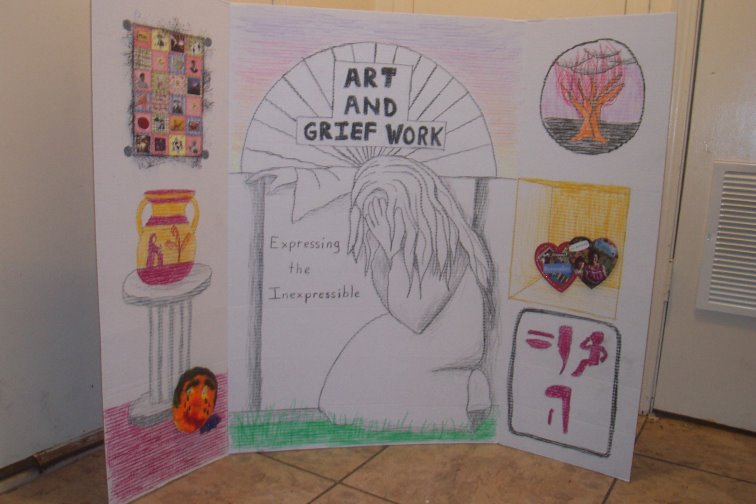
Factsheet for my oral report next week
Expressing the Inexpressible
Art in Grief Work - Fact Sheet
Art has been an integral part of grief work since the dawn of time.
“(A)rt forms have been a part of funeral ceremonies since Neanderthal times.“ - Malchiodi, C. (1998). The Art Therapy Sourcebook. (p. 142)
During the Black Plague, art took on a more morbid air, reflecting the fear, anger and sorrow which was universally felt. “Marked by crowded, paranoid compositions, ugly, menacing faces, bright colors and increased violence, Black Death art is unbalanced and uneasy.“ - Art and Death (http://death.monstrous.com/art_and_death.htm)
In the 19th century, posthumous mourning portraiture and other art became part of the morning process. - Leming, M. & Dickinson, G. (2002). Understanding Dying, Death, and Bereavement. (p 406).
Private bereavement art can take other forms besides drawing and painting.
Masks - Masks can represent “faces” of ourselves. (Allen, P. [1995]. Art is a Way of Knowing. p 81-82, 113-114) Similar to some primitive cultures, making masks of deceased loved ones helps to deal with the grief. (Allen, 127-140) Masks can also help resolve issues with long deceased relatives. (Allen, p165-167)
Collages - Using images from family photos, magazines and other sources can help a client connect and/or explore their personal history and the connections with family and society. (Allen, p 144-145)
Mandalas - Creating circular drawings helps to symbolize “wholeness” or the intention to be whole. It is often a very calming task. (Allen, p. 192) Releases tension and gives a holistic way to examine inner conflicts using Jungian principles. (Fincher, S. [1991]. Creating Mandalas - For Insight, Healing and Self-Expression. p. 24-32) Also allows the client to focus themselves mentally. (Fincher, p. 175)
Heart-shaped Memory Boxes - Heart-shaped boxes decorated usually decorated in collage-style. Allows the client to represent their public and private relationship with the deceased. (Primetime Live, March 7, 2002. “Tender Hearts - Art Helps Children of 9/11 Heal”.)
Quilts make a good community grief project, as in the AIDS Memorial Quilt. (Malchiodi, p 142-143)
Art Therapy is especially effective in grief work.
Perceived as less threatening than many traditional interventions. (Kahn, B. [1999]. “Art therapy with adolescents: Making it work for school counselors.“ ¶ 2)
It's flexible enough to be used with more than one approach and can be very client-centered, giving a safe outlet for disturbing themes. (Kahn, ¶ 5)
“(A)rt seems to appear spontaneously when confronted with a significant loss...“ (Malchiodi, p 144)
Art can be particularly helpful to those whose trauma is so severe that they can't find words for it. (Malchiodi, p 149)
“Color unlocks emotion...” (Fincher, p 172)
Damaging a piece of one's own artwork is an act of damaging the self, without actually harming the artist physically. It is a better release for self-directed anger. (Fincher, p 174)
Art in Grief Work - Fact Sheet
Art has been an integral part of grief work since the dawn of time.
“(A)rt forms have been a part of funeral ceremonies since Neanderthal times.“ - Malchiodi, C. (1998). The Art Therapy Sourcebook. (p. 142)
During the Black Plague, art took on a more morbid air, reflecting the fear, anger and sorrow which was universally felt. “Marked by crowded, paranoid compositions, ugly, menacing faces, bright colors and increased violence, Black Death art is unbalanced and uneasy.“ - Art and Death (http://death.monstrous.com/art_and_death.htm)
In the 19th century, posthumous mourning portraiture and other art became part of the morning process. - Leming, M. & Dickinson, G. (2002). Understanding Dying, Death, and Bereavement. (p 406).
Private bereavement art can take other forms besides drawing and painting.
Masks - Masks can represent “faces” of ourselves. (Allen, P. [1995]. Art is a Way of Knowing. p 81-82, 113-114) Similar to some primitive cultures, making masks of deceased loved ones helps to deal with the grief. (Allen, 127-140) Masks can also help resolve issues with long deceased relatives. (Allen, p165-167)
Collages - Using images from family photos, magazines and other sources can help a client connect and/or explore their personal history and the connections with family and society. (Allen, p 144-145)
Mandalas - Creating circular drawings helps to symbolize “wholeness” or the intention to be whole. It is often a very calming task. (Allen, p. 192) Releases tension and gives a holistic way to examine inner conflicts using Jungian principles. (Fincher, S. [1991]. Creating Mandalas - For Insight, Healing and Self-Expression. p. 24-32) Also allows the client to focus themselves mentally. (Fincher, p. 175)
Heart-shaped Memory Boxes - Heart-shaped boxes decorated usually decorated in collage-style. Allows the client to represent their public and private relationship with the deceased. (Primetime Live, March 7, 2002. “Tender Hearts - Art Helps Children of 9/11 Heal”.)
Quilts make a good community grief project, as in the AIDS Memorial Quilt. (Malchiodi, p 142-143)
Art Therapy is especially effective in grief work.
Perceived as less threatening than many traditional interventions. (Kahn, B. [1999]. “Art therapy with adolescents: Making it work for school counselors.“ ¶ 2)
It's flexible enough to be used with more than one approach and can be very client-centered, giving a safe outlet for disturbing themes. (Kahn, ¶ 5)
“(A)rt seems to appear spontaneously when confronted with a significant loss...“ (Malchiodi, p 144)
Art can be particularly helpful to those whose trauma is so severe that they can't find words for it. (Malchiodi, p 149)
“Color unlocks emotion...” (Fincher, p 172)
Damaging a piece of one's own artwork is an act of damaging the self, without actually harming the artist physically. It is a better release for self-directed anger. (Fincher, p 174)
A puzzling piece of art
Elonka's Kryptos Page
Kryptos is a sculpture located on the grounds of CIA Headquarters in Langley, Virginia. Installed in 1990, its thousands of characters contain encrypted messages, of which three have been solved (so far). There is still a fourth section at the bottom consisting of 97 or 98 characters which remains uncracked. This webpage contains some information about the sculpture, including some photos collected from around the web, some rubbings of the sculpture taken by your intrepid webmistress, links to other articles and Kryptos discussion groups here and there, and information about other encrypted sculptures which have been created by the sculptor, James Sanborn.
Kryptos is a sculpture located on the grounds of CIA Headquarters in Langley, Virginia. Installed in 1990, its thousands of characters contain encrypted messages, of which three have been solved (so far). There is still a fourth section at the bottom consisting of 97 or 98 characters which remains uncracked. This webpage contains some information about the sculpture, including some photos collected from around the web, some rubbings of the sculpture taken by your intrepid webmistress, links to other articles and Kryptos discussion groups here and there, and information about other encrypted sculptures which have been created by the sculptor, James Sanborn.
Monday, November 14, 2005
Chapter Eleven Short Essay - The Business of Dying
Before the Victorian age, funerals were times of public mourning and long sermons in most of the United States. Most people were buried wherever it was convenient. The Puritans eschewed the displays of grief and buried the dead near churches, but still gave elegies and long sermons on the fate of the living, because in their minds the dead had already had their fate sealed.
With the introduction of industrialization, the need for a third party to handle funerals and burial became great enough that people began to make a living taking care of dead. But while industrialization created a livelihood, the funeral industry made sure they shaped public expectations to make work easier for them, by convincing people to focus more on comforting the survivors than facing the death and loss. Funeral directors talked the clergy into giving shorter and more uplifting sermons. They began removing the morbid and scary images from monuments and memorials. They beautified and preserved the corpse to give them a more peaceful look. They substituted the ominous coffin for the stately casket and decorated the interior to look like a bed. In short, they worked to make it more pleasant to have a “professional” do the funeral, than to adhere to older traditions.
Even in the twentieth century, funeral homes and cemeteries influenced burial traditions. The introduction of “lawn cemeteries” appeared. While they may argue that this is a far more peaceful atmosphere for grieving people, the ease of caring for a lawn cemetery is obviously a savings for whomever maintains them. As is the push to standardize grave markers and minimalize the amount of personalization of them. While the industry calls it aesthetics and making it more economical for the consumer, there is no doubt the main beneficiary is the industry itself.
With the introduction of industrialization, the need for a third party to handle funerals and burial became great enough that people began to make a living taking care of dead. But while industrialization created a livelihood, the funeral industry made sure they shaped public expectations to make work easier for them, by convincing people to focus more on comforting the survivors than facing the death and loss. Funeral directors talked the clergy into giving shorter and more uplifting sermons. They began removing the morbid and scary images from monuments and memorials. They beautified and preserved the corpse to give them a more peaceful look. They substituted the ominous coffin for the stately casket and decorated the interior to look like a bed. In short, they worked to make it more pleasant to have a “professional” do the funeral, than to adhere to older traditions.
Even in the twentieth century, funeral homes and cemeteries influenced burial traditions. The introduction of “lawn cemeteries” appeared. While they may argue that this is a far more peaceful atmosphere for grieving people, the ease of caring for a lawn cemetery is obviously a savings for whomever maintains them. As is the push to standardize grave markers and minimalize the amount of personalization of them. While the industry calls it aesthetics and making it more economical for the consumer, there is no doubt the main beneficiary is the industry itself.
Sunday, November 13, 2005
Chapter Ten Short Essay - Death Rituals
As varied as death rituals are around the world, like other rites of passage, they all consist of three parts. The first is the separation of the bereaved from the non-bereaved. In most cultures, this is not actually a physical separation as it is identifying the affected people through marking them as mourners. This can be accomplished through a change of clothing and adornment and/or actions that are not commonly used during normal life. Sometimes the bereaved do separate themselves physically from others to be alone with their grief. They withdraw themselves from work and other social activities. Depending on the culture, the mourners can be extremely quiet and stoic about their loss or everyone may take the opportunity to wail and release their sorrow in a physically intense manner. In general, women are expected to take longer at this than men. Many cultures allow men to remarry sooner than women after the death of a spouse without social reprisals.
The second part is the transition from being a part of the society to being accepted as dead. With some cultures this is a relatively short part, taking only as long as it does to bury the body (or send it to professionals to do it) and getting the paperwork done to take care of the estate and notify the government. In other cultures, it can take up to three years and even a few reburials.
Once the deceased has been ritualistically declared no longer a living part of society, the reintegration of the mourners into society occurs. This is done usually through a large meal or party, where people can begin to shed their more visible mourning behavior and return to a normal daily routine.
The second part is the transition from being a part of the society to being accepted as dead. With some cultures this is a relatively short part, taking only as long as it does to bury the body (or send it to professionals to do it) and getting the paperwork done to take care of the estate and notify the government. In other cultures, it can take up to three years and even a few reburials.
Once the deceased has been ritualistically declared no longer a living part of society, the reintegration of the mourners into society occurs. This is done usually through a large meal or party, where people can begin to shed their more visible mourning behavior and return to a normal daily routine.
Chapter Nine Short Essay - Suicide
In general, suicides occur in the context of social connectivity. The people most likely to commit suicide either have too few social ties (troubled adolescents) or too many (high stressed occupations). Changes in social ties like deaths, divorces, unemployment, retirement and relocation, also increases the likelihood of suicide.
Child suicides are more prevalent in homes where family ties are disrupted and/or other members have committed suicide. Adolescent suicides have the same risk factors as child ones, with the extra dimension of poor peer relations. Adolescents are also more likely to commit copycat suicides. Adult suicides are more influenced by personal losses, though parents are less likely to commit suicide than non-parents.
Elderly suicide is most likely to be a rational suicide where the older person decides to end their life in an effort to make life easier for those around them. Another cause of elderly suicide is an inability to adjust to retirement or widowhood. While other age groups are prone to suicide gestures, the elderly are far more likely to be successful with their suicides. They approach suicide with a great deal of forethought and planning. In most cases, they give no warning to their friends and family. However, they usually make sure that their other affairs are in order and try to leave a minimal amount of mess to clean up.
Social driven suicides, or honorable suicides, only occur in cultures where they are accepted. Even in some cultures that abhor suicides, certain reasons for killing one's self are considered acceptable if they are done to support a higher moral principle. Some cultures will change their acceptance of suicides when it begins to impact society.
Child suicides are more prevalent in homes where family ties are disrupted and/or other members have committed suicide. Adolescent suicides have the same risk factors as child ones, with the extra dimension of poor peer relations. Adolescents are also more likely to commit copycat suicides. Adult suicides are more influenced by personal losses, though parents are less likely to commit suicide than non-parents.
Elderly suicide is most likely to be a rational suicide where the older person decides to end their life in an effort to make life easier for those around them. Another cause of elderly suicide is an inability to adjust to retirement or widowhood. While other age groups are prone to suicide gestures, the elderly are far more likely to be successful with their suicides. They approach suicide with a great deal of forethought and planning. In most cases, they give no warning to their friends and family. However, they usually make sure that their other affairs are in order and try to leave a minimal amount of mess to clean up.
Social driven suicides, or honorable suicides, only occur in cultures where they are accepted. Even in some cultures that abhor suicides, certain reasons for killing one's self are considered acceptable if they are done to support a higher moral principle. Some cultures will change their acceptance of suicides when it begins to impact society.
Tuesday, November 08, 2005
My Funeral Home Field Trip Summary
Visit to Mercer-Adams Funeral Home
November 7, 2005
I was very impressed with our tour of the Mercer-Adams Funeral Home. The atmosphere there was warm and soothing. Funeral Director Amy Brown was extremely knowledgeable and easy to talk to. I appreciated her ability to give details, such as how a body is handled if the medical examiner finds something suspicious and what legalities are involved when transporting a body over state lines.
It was very interesting to hear how the funeral home accommodated different types of funeral services. Especially the Taiwanese funerals that take about three days to do. I found her observation of how the Taiwanese are more attached to the body interesting, since I did not expect that from the Westerner interpretation of Buddism I have been exposed to. I was always given the impression that the body was merely an impediment to spiritual perfection. However, this is probably an example of how traditions and ideas do not always translate fully into other cultures. It also is probably more of a reflection of how many Eastern cultures are more death-accepting than Western ones.
Ms. Brown also explained how the industry is regulated for quality. The state commission does surprised inspections and not only checks the facilities, but also how the paperwork is handled. She did not mention anything about needing to have their procedures written down, but if so, then the industry is practically ISO compliant. The funeral home also was careful when choosing a crematorium to work with, selecting one that kept track of the remains through a fire-proof tagging system. Mercer-Adams dedication to their deceased clients is obvious in the fact that they still hold on to unclaimed ashes even after several years, just in case someone of the family decides to retrieve them.
Funeral directors must interact with the family while the grief is still numbing. As Ms. Brown said, the shock is a bit of the blessing, since it helps the family to deal with the many arrangements that must be taken care of right after the death. Within two and a half hours, Ms. Brown leads the family through a whole lists of decisions and helps them by not only taking care of things like contacting the cemetery and florist, but also giving them a list of things the family had to take care of, like deciding on pall bearers and the type of funeral.
It is interesting that many features of caskets are more reflective of the fears of the living than the needs of the dead. For instance, unless someone is sending a body to another country, which must be hermetically sealed, there really is not a reason to have a sealed casket except for the fear of being eaten by insects and mold. Because of their beliefs, Orthodox Jews are buried in special wooden caskets that do not have any metal in their construction. After seeing the elaborate adult caskets, it was a bit disturbing to find that child caskets are often consist of a plastic shell and closed with a sealant. I can only assume it is because parents of young children often do not have the money for more elaborate caskets.
I found the embalming room very clean and strongly smelled of bleach. It was interesting to know just how non-intrusive most embalmings are. Just one cut into the skin and then opening a vein and injecting the fluid into a major artery. The fluid is custom mixed for each body and the pump does all the work. When there is problems with circulation, other small incisions are made, but since it is the circulatory system that does the delivery, it is to the embalmer's benefit to keep it as intact as possible. It is after the blood has been replace and the body has set a while that the abdominal fluid is replaced with a thicker solution to kill off the internal bacteria.
It was good to know that Ms. Brown took the time and effort to keep herself from burning out. From exercise to missionary trips to Honduras, it is obvious that she does her best to balance her life. I suspect that the care she takes for her own well-being helps a great deal when she is working with grieving families.
November 7, 2005
I was very impressed with our tour of the Mercer-Adams Funeral Home. The atmosphere there was warm and soothing. Funeral Director Amy Brown was extremely knowledgeable and easy to talk to. I appreciated her ability to give details, such as how a body is handled if the medical examiner finds something suspicious and what legalities are involved when transporting a body over state lines.
It was very interesting to hear how the funeral home accommodated different types of funeral services. Especially the Taiwanese funerals that take about three days to do. I found her observation of how the Taiwanese are more attached to the body interesting, since I did not expect that from the Westerner interpretation of Buddism I have been exposed to. I was always given the impression that the body was merely an impediment to spiritual perfection. However, this is probably an example of how traditions and ideas do not always translate fully into other cultures. It also is probably more of a reflection of how many Eastern cultures are more death-accepting than Western ones.
Ms. Brown also explained how the industry is regulated for quality. The state commission does surprised inspections and not only checks the facilities, but also how the paperwork is handled. She did not mention anything about needing to have their procedures written down, but if so, then the industry is practically ISO compliant. The funeral home also was careful when choosing a crematorium to work with, selecting one that kept track of the remains through a fire-proof tagging system. Mercer-Adams dedication to their deceased clients is obvious in the fact that they still hold on to unclaimed ashes even after several years, just in case someone of the family decides to retrieve them.
Funeral directors must interact with the family while the grief is still numbing. As Ms. Brown said, the shock is a bit of the blessing, since it helps the family to deal with the many arrangements that must be taken care of right after the death. Within two and a half hours, Ms. Brown leads the family through a whole lists of decisions and helps them by not only taking care of things like contacting the cemetery and florist, but also giving them a list of things the family had to take care of, like deciding on pall bearers and the type of funeral.
It is interesting that many features of caskets are more reflective of the fears of the living than the needs of the dead. For instance, unless someone is sending a body to another country, which must be hermetically sealed, there really is not a reason to have a sealed casket except for the fear of being eaten by insects and mold. Because of their beliefs, Orthodox Jews are buried in special wooden caskets that do not have any metal in their construction. After seeing the elaborate adult caskets, it was a bit disturbing to find that child caskets are often consist of a plastic shell and closed with a sealant. I can only assume it is because parents of young children often do not have the money for more elaborate caskets.
I found the embalming room very clean and strongly smelled of bleach. It was interesting to know just how non-intrusive most embalmings are. Just one cut into the skin and then opening a vein and injecting the fluid into a major artery. The fluid is custom mixed for each body and the pump does all the work. When there is problems with circulation, other small incisions are made, but since it is the circulatory system that does the delivery, it is to the embalmer's benefit to keep it as intact as possible. It is after the blood has been replace and the body has set a while that the abdominal fluid is replaced with a thicker solution to kill off the internal bacteria.
It was good to know that Ms. Brown took the time and effort to keep herself from burning out. From exercise to missionary trips to Honduras, it is obvious that she does her best to balance her life. I suspect that the care she takes for her own well-being helps a great deal when she is working with grieving families.
Death and Dying discussion questions
Chapter Five Questions
2. Would you prefer to live with a person who is terminally ill or a person who is chemically dependent? Discuss the advantages and disadvantages of each.
It would depend on the specifics of the disease and the dependency, but in general I would prefer to live with a terminally ill person. With a terminally ill person, I would be more likely to have meaningful communications with them and succeed in some way in making the end of their life better by making sure that they don't die alone. True, there would be a lot of physical caretaking and little sleep, but at least there would be an end, even if it didn't feel that way sometimes. A chemically dependent person on the other hand, would be more mobile and possibly more destructive. I would also have to stay one step ahead of them for their sake and my own sanity, especially since I would be trying to help them to get over their addiction. A chemically dependent person usually loses more of their ability to temper their emotional outbursts than a terminally ill person.
7. Discuss Glasser and Strauss's four awareness contexts. Which do you think more often exists in a medical setting with a dying patient?
Closed Awareness - Patient is not told the truth about their condition or was “told” and refused to hear it. This is an unstable context of awareness since most patients are able to pick up on death-related situational and spatial clues. According to one study, nurses prefer to work in this context more often.
Suspicion Awareness - Patient suspects the truth, but receives no verification from the medical staff. This requires the medical staff to be united on not telling the patient. It is possible that it is an unspoken agreement, justified by excuses as in they just haven't found the right time to tell the patient yet. Legislation has reduced context over the years as patients are given more of a right to know the truth about their health.
Mutual Pretense - Everyone, including the patient, knows that the patient's condition is terminal, but all are pretending that the patient is going to beat the odds and live anyway. Considering the weight American doctors and others place on surviving as a measure of success and competency of a medical professional, this is probably the most frequent occurring context in a medical setting in the United States.
Open Awareness - Everyone knows the patient is going to die and are working towards a “proper” death for the patient. A study in England showed that most of the doctors there preferred this context. Unfortunately, the dying patient usually has no clue what a “proper” death is supposed to be like and often receives less care when they don't act as the medical staff expects them to.
Chapter Six Questions
1) What is hospice care? How does it differ from the treatment given by most acute-care hospitals? Identify the major functions of a hospice program.
Hospice is a form a palliative care, where the main goal is to “care” for the patient and family,while most acute-care hospitals focus almost exclusively on “curing” the patient. Not only are the physical needs considered, but also the psychological, social, financial and spiritual needs. The three primary concerns of hospice care are symptom and pain control, the apprehension caused by having others in control of one's life, and the anxiety about being alone at the time of death.
4) Pain control is not a goal of all dying patients. Discuss the cultural ramifications of controlling pain.
While there really isn't any reason for most dying patients to be in pain with the pain-killing medicines we have available, there are many reasons why some patients would rather deal with the pain than the drugs. One is the worry that the medicine will dull their mental capacity and the patient won't be able to interact with other on a meaningful level because of being sedated. Cultural reasons include beliefs about avoiding drugs, showing strength in the face of the final adversity, and the idea in some cultures that dying in pain means an honorable death. Enduring pain may be considered more natural and acceptable by some patients.
Chapter Seven Questions
2) How does “labeling theory” tend to make one a “deviant“?
It creates a set of accepted “norms” through labeling what is expected and what is not. Anything that cannot be given a normal label, becomes deviant and an area of insecurity for those indoctrinated with the labels.
5) Why do you think the medical schools have traditionally offered very little death education?
Because it runs counter to the overwhelming cultural belief of doctors being able to cure everything and therefore a very uncomfortable subject for many to deal with. After all, doctors help people live. If a doctor helped people die, it might be considered murder. The concept of care versus cure does not exist in most medical schools, so the idea of caring for someone who is dying creates confusion when compared to the rest of the medical education.
Chapter Eight Questions
1) Compare and contrast passive and active euthanasia. What difficulties does implementing each of these approaches have for current social policy dealing with health care for the terminally ill?
Passive euthanasia is allowing someone to die by not implementing measures that could prolong their life. It is legal in most of the technological countries of the world. While many people consider it acceptable and even preferable, there are some who see it as immoral not to do everything possible to sustain life, especially people who place the sanctity of life over the quality of life.
Active euthanasia is when the patient and/or doctor does something to accelerate the dying process. This is illegal in most countries and comparable to suicide or murder. Many fear that taking this path will lead to the slippery slope of a society choosing to euthanize non-terminal people who are not considered useful to that society.
Interestingly, quality of life is more of a concern for those in well-to-do segments of society. People who have had experienced more suffering and discomfort due to living in lower social economic levels tend to care more for the sanctity of life, since for them pain and misery is a common part of life and not a reason to end it.
6) Discuss your reaction to Dr. Timothy Quill's assisting his patient with leukemia, “Diane,” with her death.
Though I probably wouldn't have told her of the Hemlock Society, I'm not exactly appalled at him for giving her medication to do what she did. First off, he gave her directions for how to use the medicine in a non-life threatening way, before telling her the toxic doses. That gave her the chance to use the medicine in another, more acceptable, way. With that education, she could make her own decision. It was also obvious that he would have prefer she tried to stay alive and I believe that was obvious to her too, since she waited several months before finally doing it. And by making her tell him before she did, he made her more accountable for her actions because she couldn't just sneak in her suicide, she had to actually face the reality that she was ending her life.
Though I am a religious person and believe that suicide is wrong, I also believe that how accountable a person is for taking there own life depends on their knowledge and understanding of what they are doing. I also believe that I cannot know for sure how accountable they are and it's not my place to make that decision anyway. I don't condemn the doctor because while he did give her the means, he also gave her a clear knowledge of what she was considering. The was a very good chance that had he not educated her, she would have found another way to overdose herself.
2. Would you prefer to live with a person who is terminally ill or a person who is chemically dependent? Discuss the advantages and disadvantages of each.
It would depend on the specifics of the disease and the dependency, but in general I would prefer to live with a terminally ill person. With a terminally ill person, I would be more likely to have meaningful communications with them and succeed in some way in making the end of their life better by making sure that they don't die alone. True, there would be a lot of physical caretaking and little sleep, but at least there would be an end, even if it didn't feel that way sometimes. A chemically dependent person on the other hand, would be more mobile and possibly more destructive. I would also have to stay one step ahead of them for their sake and my own sanity, especially since I would be trying to help them to get over their addiction. A chemically dependent person usually loses more of their ability to temper their emotional outbursts than a terminally ill person.
7. Discuss Glasser and Strauss's four awareness contexts. Which do you think more often exists in a medical setting with a dying patient?
Closed Awareness - Patient is not told the truth about their condition or was “told” and refused to hear it. This is an unstable context of awareness since most patients are able to pick up on death-related situational and spatial clues. According to one study, nurses prefer to work in this context more often.
Suspicion Awareness - Patient suspects the truth, but receives no verification from the medical staff. This requires the medical staff to be united on not telling the patient. It is possible that it is an unspoken agreement, justified by excuses as in they just haven't found the right time to tell the patient yet. Legislation has reduced context over the years as patients are given more of a right to know the truth about their health.
Mutual Pretense - Everyone, including the patient, knows that the patient's condition is terminal, but all are pretending that the patient is going to beat the odds and live anyway. Considering the weight American doctors and others place on surviving as a measure of success and competency of a medical professional, this is probably the most frequent occurring context in a medical setting in the United States.
Open Awareness - Everyone knows the patient is going to die and are working towards a “proper” death for the patient. A study in England showed that most of the doctors there preferred this context. Unfortunately, the dying patient usually has no clue what a “proper” death is supposed to be like and often receives less care when they don't act as the medical staff expects them to.
Chapter Six Questions
1) What is hospice care? How does it differ from the treatment given by most acute-care hospitals? Identify the major functions of a hospice program.
Hospice is a form a palliative care, where the main goal is to “care” for the patient and family,while most acute-care hospitals focus almost exclusively on “curing” the patient. Not only are the physical needs considered, but also the psychological, social, financial and spiritual needs. The three primary concerns of hospice care are symptom and pain control, the apprehension caused by having others in control of one's life, and the anxiety about being alone at the time of death.
4) Pain control is not a goal of all dying patients. Discuss the cultural ramifications of controlling pain.
While there really isn't any reason for most dying patients to be in pain with the pain-killing medicines we have available, there are many reasons why some patients would rather deal with the pain than the drugs. One is the worry that the medicine will dull their mental capacity and the patient won't be able to interact with other on a meaningful level because of being sedated. Cultural reasons include beliefs about avoiding drugs, showing strength in the face of the final adversity, and the idea in some cultures that dying in pain means an honorable death. Enduring pain may be considered more natural and acceptable by some patients.
Chapter Seven Questions
2) How does “labeling theory” tend to make one a “deviant“?
It creates a set of accepted “norms” through labeling what is expected and what is not. Anything that cannot be given a normal label, becomes deviant and an area of insecurity for those indoctrinated with the labels.
5) Why do you think the medical schools have traditionally offered very little death education?
Because it runs counter to the overwhelming cultural belief of doctors being able to cure everything and therefore a very uncomfortable subject for many to deal with. After all, doctors help people live. If a doctor helped people die, it might be considered murder. The concept of care versus cure does not exist in most medical schools, so the idea of caring for someone who is dying creates confusion when compared to the rest of the medical education.
Chapter Eight Questions
1) Compare and contrast passive and active euthanasia. What difficulties does implementing each of these approaches have for current social policy dealing with health care for the terminally ill?
Passive euthanasia is allowing someone to die by not implementing measures that could prolong their life. It is legal in most of the technological countries of the world. While many people consider it acceptable and even preferable, there are some who see it as immoral not to do everything possible to sustain life, especially people who place the sanctity of life over the quality of life.
Active euthanasia is when the patient and/or doctor does something to accelerate the dying process. This is illegal in most countries and comparable to suicide or murder. Many fear that taking this path will lead to the slippery slope of a society choosing to euthanize non-terminal people who are not considered useful to that society.
Interestingly, quality of life is more of a concern for those in well-to-do segments of society. People who have had experienced more suffering and discomfort due to living in lower social economic levels tend to care more for the sanctity of life, since for them pain and misery is a common part of life and not a reason to end it.
6) Discuss your reaction to Dr. Timothy Quill's assisting his patient with leukemia, “Diane,” with her death.
Though I probably wouldn't have told her of the Hemlock Society, I'm not exactly appalled at him for giving her medication to do what she did. First off, he gave her directions for how to use the medicine in a non-life threatening way, before telling her the toxic doses. That gave her the chance to use the medicine in another, more acceptable, way. With that education, she could make her own decision. It was also obvious that he would have prefer she tried to stay alive and I believe that was obvious to her too, since she waited several months before finally doing it. And by making her tell him before she did, he made her more accountable for her actions because she couldn't just sneak in her suicide, she had to actually face the reality that she was ending her life.
Though I am a religious person and believe that suicide is wrong, I also believe that how accountable a person is for taking there own life depends on their knowledge and understanding of what they are doing. I also believe that I cannot know for sure how accountable they are and it's not my place to make that decision anyway. I don't condemn the doctor because while he did give her the means, he also gave her a clear knowledge of what she was considering. The was a very good chance that had he not educated her, she would have found another way to overdose herself.
Friday, October 28, 2005
My Obituary
If I could have my preference, I would want my obituary written by the staff of the New York Times. Seriously, these people write great obituaries. However, my textbook suggests that I should try writing my own obituary as a ways to accept my own mortality. Looking at my syllabus, it's not going to be a class assignment, but I am going to write the obituary I wish could be published, though I suspect my surviving relatives would have a fit if it was used. Of course, "Cosmic Siren" would be replaced with my real name and the specific information filled in.
Cosmic Siren Dead at Last
After ___ years of surviving many things through sheer luck and stubborness, _________ resident Cosmic Siren finally died on ____________ at ____ from ___________________.
A very serious and responsible child, Cosmic didn't find her true path in life until her late thirties. At which time, the very proper and quiet persona she had up until then presented to the rest of humanity was unceremoniously peeled away and replaced with an eccentric intensity and a determination to bring the healing of art to those who would otherwise overlook it.
Her achievements include raising two wonderful children, archetypal symbolism research, books on a range of subjects, and various other things.
In addition to her children, she is survived by ____ siblingsand unnumbered minions. She will be missed, if only because she made life just a little more interesting by her presence.
Death, Grief and Bereavement homework.
Yes, I am back in school again. My Death, Grief and Bereavement module starts October 31st. Here's my first essay for the class.
Obituary Content Comparisons
When I started this assignment, I had the preconceived notion that the likelihood of an obituary being death denying would be less for a larger metropolis than it would for smaller urban areas. I was quite surprised to find out I was wrong. I was also wrong in my assumption that staff-written obituaries would be more death accepting than those written by someone who knew the deceased person personally. I compared six different newspaper sites and it is my suspicion that the degree of death accepting language depends more on regional culture than anything else.
The first two newspapers I compared were the NY and LA Times. The NY Times obituaries (http://www.nytimes.com/pages/obituaries/) were obviously staff written. The short obituaries were focused on the factual statistic information in death accepting language with a title giving identifying phrase (either occupation or a defining achievement) of deceased linked to a longer, more detailed summary of their achievements while alive. They were the type of obituaries I expected see from an internationally read newspaper. The LA Times obituaries (http://www.latimes.com/news/obituaries/) were probably staff written and while factual about death and time of it, they were somewhat death denying in that they avoided using the words death and died in titles, which were often preceded by the euphemism “passings“. The longer description were shorter than the NY Times full obituaries. Exceptions were made for military deaths, where the word “killed” and “dies” did make it into the obituary titles. Apparently military deaths are supposed to be accepted bluntly, while civilian deaths are to be handled carefully.
The next two newspapers I compared were The Oklahoman and The Dallas Morning News. The Oklahoman obituaries (http://www.newsok.com/news/obituaries/) were usually written by someone who personally knew the deceased and sent to the paper. Most of these obituaries gave vital statistics, genealogical (parents, surviving family) and memorial service information. Occassionally some personal information of the decease was printed. Almost all of them were death accepting in their language, perhaps due to their brevity. In stark contrast, the staff written obituaries of The Dallas Morning News (http://www.dallasnews.com/obituaries/) were definitely death denying in that they focused more on the human interest element. Readers were presented with the wonderful qualities of the deceased person, with the information about the actual death worked into either the middle or the end.
The last two newspapers I compared were from smaller cities: Norman, Oklahoma, and San Marcos, Texas. Both papers used non-staff written obituaries and unlike the obituaries in the Oklahoman, there did not appear to be a size limit to the obituaries submitted. The information presented varied by individual obituary. Some were just the date and time of death and city of residence of the decease. Others were short life histories. However, the obituaries of The Norman Transcript (http://www.normantranscript.com/obituaries) were more death accepting than those of The San Marcos Daily Record (http://sanmarcosrecord.com/obituaries/), which were mostly death denying or acceptance soften with soothing adjectives.
The content of the staff written obituaries were probably dictated by either the newspaper's or editor's philosophies philosophies. Whether or not they accurately depict the general cultural approach to death is not clear. However, the submitted obituaries, especially those that were not limited in length showed more of a cultural angle in how the information was presented.
Obituary Content Comparisons
When I started this assignment, I had the preconceived notion that the likelihood of an obituary being death denying would be less for a larger metropolis than it would for smaller urban areas. I was quite surprised to find out I was wrong. I was also wrong in my assumption that staff-written obituaries would be more death accepting than those written by someone who knew the deceased person personally. I compared six different newspaper sites and it is my suspicion that the degree of death accepting language depends more on regional culture than anything else.
The first two newspapers I compared were the NY and LA Times. The NY Times obituaries (http://www.nytimes.com/pages/obituaries/) were obviously staff written. The short obituaries were focused on the factual statistic information in death accepting language with a title giving identifying phrase (either occupation or a defining achievement) of deceased linked to a longer, more detailed summary of their achievements while alive. They were the type of obituaries I expected see from an internationally read newspaper. The LA Times obituaries (http://www.latimes.com/news/obituaries/) were probably staff written and while factual about death and time of it, they were somewhat death denying in that they avoided using the words death and died in titles, which were often preceded by the euphemism “passings“. The longer description were shorter than the NY Times full obituaries. Exceptions were made for military deaths, where the word “killed” and “dies” did make it into the obituary titles. Apparently military deaths are supposed to be accepted bluntly, while civilian deaths are to be handled carefully.
The next two newspapers I compared were The Oklahoman and The Dallas Morning News. The Oklahoman obituaries (http://www.newsok.com/news/obituaries/) were usually written by someone who personally knew the deceased and sent to the paper. Most of these obituaries gave vital statistics, genealogical (parents, surviving family) and memorial service information. Occassionally some personal information of the decease was printed. Almost all of them were death accepting in their language, perhaps due to their brevity. In stark contrast, the staff written obituaries of The Dallas Morning News (http://www.dallasnews.com/obituaries/) were definitely death denying in that they focused more on the human interest element. Readers were presented with the wonderful qualities of the deceased person, with the information about the actual death worked into either the middle or the end.
The last two newspapers I compared were from smaller cities: Norman, Oklahoma, and San Marcos, Texas. Both papers used non-staff written obituaries and unlike the obituaries in the Oklahoman, there did not appear to be a size limit to the obituaries submitted. The information presented varied by individual obituary. Some were just the date and time of death and city of residence of the decease. Others were short life histories. However, the obituaries of The Norman Transcript (http://www.normantranscript.com/obituaries) were more death accepting than those of The San Marcos Daily Record (http://sanmarcosrecord.com/obituaries/), which were mostly death denying or acceptance soften with soothing adjectives.
The content of the staff written obituaries were probably dictated by either the newspaper's or editor's philosophies philosophies. Whether or not they accurately depict the general cultural approach to death is not clear. However, the submitted obituaries, especially those that were not limited in length showed more of a cultural angle in how the information was presented.
Wednesday, October 26, 2005
Schizophrenics Better at Discerning Illusions
Schizophrenics Better at Discerning Illusions
In other news, I start going back to school October 31st.
Optical illusions that fool most people don't seem to trick those who suffer from schizophrenia, concludes a study published in the latest issue of Current Biology. The success may actually be linked to a weakness in a brain mechanism called contextual processing, which is responsible for picking out relevant sensory information from the barrage of stimuli a person constantly experiences. If that's the case, it may explain why some schizophrenics misunderstand other people's actions in the context of a situation or feel paranoia or persecution.
In other news, I start going back to school October 31st.
Saturday, October 01, 2005
Change a setting
You'll now have to do the "type the letters in the box to verify" thing.
Been getting spambots. Ironically, the first entry they hit was one on scams.
Been getting spambots. Ironically, the first entry they hit was one on scams.
Fruit Bowls
Margaret Dorfman
Margaret Dorfman makes her delicate parchment bowls by hand from over 35 different types of fresh fruits and vegetables. The fruits and vegetables are cured for several days and then pressed, dried and aged into paper-thin, translucent vessels. She calls her pieces Fruit and Vegetable Parchment because their texture and translucency call to mind the skin parchments of medieval Europe. As each bowl is carefully hand-shaped and formed, so each is unique.
Saturday, September 17, 2005
Finally had the surgery
Was released from the hospital last night. Quick summary here.
Found out the possible source of my extreme weakness and illness of the past few months. My hemoglobin count before the surgery was around 6.9. I had to be given two pints of blood before I could be operated on. I was given another two units during the surgery, even though I hardly lost any blood. At 2 am the morning after, my hemoglobin count was around 9.8. Just having the transfusions helped me feel better.
The chief anesthesiologist was very worried about how my levels got so low. Asked about if my bone marrow had any problems, but I wasn't anemic three months ago. However, I did lose a lot of blood back then - enough to make me so weak that I had stay with my parents for two weeks. The scary thing is that my body did not replace the blood by now. I have lost 3 pints before and recovered my strength a couple of weeks later.
Anyway, between that and having some breathing problems near the end of the surgery, they decided to make it only a partial hysterectomy, but they said my ovaries looked healthy and it wasn't worth the risk to go after them too.
I am doing well now. Even with the normal surgery pain, I actually can walk farther now, than I could before the surgery. So despite everything, I consider it a success.
Anyway, I forgot to mention that after all that trouble to get the kids to cook before my surgery, and making all those frozen entries - Thursday night instead of defrosting what we already made, my children actually went ahead a cooked a fresh meal for themselves. Apparently, it's easier to think straighter about food when Mom's not around than it is when she's around and sick.
My cat George kept looking for me while I was gone. He kept finding clothing with my scent on to sleep on. We're all at my parents right now, me, the kids and the cats. The kitties have seen how miserable I am and know that I don't liked being laid on. They have beeen very considerate of my wishes so far.
The nurses loved me. They would come and chat with me after they had a rough patien to deal with and I would tell them to take care of themselves, like I was perfectly okay and they were the ones needing the sympathy. But they sort did need it more. My next door neighbor was a very childlike and most of the time she was just cute carrying around her baby doll and chittering. But yesterday, she kept throwing crying fits when they had to take blood for test updates. They also had a patient die yesterday morning and another one who had to be restrained a bit. I don't know what his problem was, but he sounded like he was coming down from something.
I found it amusing that in recovery, the women were laying there quietly as they woke up from anesthesia, but the two male patients were moaning and groaning and making all sorts of horrible noises, but it was the fear noises, not real agony ones. If you've ever raised a toddler, you will know what I"m talking about. The nurses (male and female) finally got both men to realize that they were okay and the surgery was done. But really, I guess it would be really scary to the unconscious to be in a position of weekness as an adult, when you're used to having "control" most of the time.
My children, pets and I are currently with my parents.
Well, it keeps my blood pressure up. Seriously. I was showing a blood pressure of 68/65 about 20 minutes ago. Mom started to tell me I was doing it wrong - like I haven't used this unit several times in the past 3 years. By the time we finished, my reading was 128/67 and my pulse went from 63 to 84 beats per minute.
So far, she's griped about all her doctors, recited imagined crimes of her elementary classmates - "I was too naive to know then, but now I know more and they were actually going to do (some horrible crime that makes no sense without a motive) to me." *rolls eyes*
BTW, the classmate thing came out because she's trying to prove that they got DDT poisoning during their school years.
Also have been treated to a diatribe about my dad and some socioeconomic rant - and I have been here just over 12 hours.
I'm going to go back to sleep. My painkillers are starting to hit me hard.
Found out the possible source of my extreme weakness and illness of the past few months. My hemoglobin count before the surgery was around 6.9. I had to be given two pints of blood before I could be operated on. I was given another two units during the surgery, even though I hardly lost any blood. At 2 am the morning after, my hemoglobin count was around 9.8. Just having the transfusions helped me feel better.
The chief anesthesiologist was very worried about how my levels got so low. Asked about if my bone marrow had any problems, but I wasn't anemic three months ago. However, I did lose a lot of blood back then - enough to make me so weak that I had stay with my parents for two weeks. The scary thing is that my body did not replace the blood by now. I have lost 3 pints before and recovered my strength a couple of weeks later.
Anyway, between that and having some breathing problems near the end of the surgery, they decided to make it only a partial hysterectomy, but they said my ovaries looked healthy and it wasn't worth the risk to go after them too.
I am doing well now. Even with the normal surgery pain, I actually can walk farther now, than I could before the surgery. So despite everything, I consider it a success.
Anyway, I forgot to mention that after all that trouble to get the kids to cook before my surgery, and making all those frozen entries - Thursday night instead of defrosting what we already made, my children actually went ahead a cooked a fresh meal for themselves. Apparently, it's easier to think straighter about food when Mom's not around than it is when she's around and sick.
My cat George kept looking for me while I was gone. He kept finding clothing with my scent on to sleep on. We're all at my parents right now, me, the kids and the cats. The kitties have seen how miserable I am and know that I don't liked being laid on. They have beeen very considerate of my wishes so far.
The nurses loved me. They would come and chat with me after they had a rough patien to deal with and I would tell them to take care of themselves, like I was perfectly okay and they were the ones needing the sympathy. But they sort did need it more. My next door neighbor was a very childlike and most of the time she was just cute carrying around her baby doll and chittering. But yesterday, she kept throwing crying fits when they had to take blood for test updates. They also had a patient die yesterday morning and another one who had to be restrained a bit. I don't know what his problem was, but he sounded like he was coming down from something.
I found it amusing that in recovery, the women were laying there quietly as they woke up from anesthesia, but the two male patients were moaning and groaning and making all sorts of horrible noises, but it was the fear noises, not real agony ones. If you've ever raised a toddler, you will know what I"m talking about. The nurses (male and female) finally got both men to realize that they were okay and the surgery was done. But really, I guess it would be really scary to the unconscious to be in a position of weekness as an adult, when you're used to having "control" most of the time.
My children, pets and I are currently with my parents.
Well, it keeps my blood pressure up. Seriously. I was showing a blood pressure of 68/65 about 20 minutes ago. Mom started to tell me I was doing it wrong - like I haven't used this unit several times in the past 3 years. By the time we finished, my reading was 128/67 and my pulse went from 63 to 84 beats per minute.
So far, she's griped about all her doctors, recited imagined crimes of her elementary classmates - "I was too naive to know then, but now I know more and they were actually going to do (some horrible crime that makes no sense without a motive) to me." *rolls eyes*
BTW, the classmate thing came out because she's trying to prove that they got DDT poisoning during their school years.
Also have been treated to a diatribe about my dad and some socioeconomic rant - and I have been here just over 12 hours.
I'm going to go back to sleep. My painkillers are starting to hit me hard.
Sunday, September 11, 2005
A constitutional republic
I was sent an article from a major publication recently and it occurred to me for the umpteen hundredth time that most people slept through their US Government classes.
If you check out the US entry in the CIA World Factbook, you will see that we are listed as a Constitution-based federal republic; strong democratic tradition.
Now, when this country was first created, it had thirteen former colonies that had very different cultures and ideals. None of these newly declared states wanted to totally give up their rights of self-government to a central government. They wanted to be able to decide certain things themselves. If those people on the other side of the state line wanted something different - more power to them.
But there were worries that a strong federal government might override the states' sovereignty by using the excuse of an emergency to come in and take control. And actually, JFK sort of did this in 1963 against Gov. George Wallace, ordering the governor's own National Guard to turn against him and forcibly integrate the University of Alabama. Of course that was to uphold a federal mandate. In the case of looters, who are breaking no evident federal law, the Posse Comitatus Act of 1878 explicitly forbids using the military (unless a governor uses her National Guard under "state status") in a domestic police function.
What this means is that according to the law, the STATES are given the chance to solve the problem themselves FIRST. The federal government is not allowed to step in without the governor's permission. After all, the governor is supposed to have a better idea of what the citizens of his state are in need of than the feds in Washington D.C. Only when the state government cannot handle a crisis that the feds have the right to step in. Theorhetically, a president could get impeached for infringing on a state's sovereignty - that would indeed be seen as a move towards dictatorship.
This part of the reason I get so disgusted with the ignorant people make comments about any president having dictator-like powers. The state governors have powers that keeps this from happening. But if we keep insisting that the federal government fix everything immediately, then we weaken that check and balance. Of course, there is something in place when the governor does screw up and the president should step in then, but we shouldn't be so surprised when they don't step in immediately. Presidents who have done so in the past always get flack for doing it, no matter what their political party.
I'm not saying that everything worked like it should recently. In fact, I think there were major screw-ups on all levels and Brown deserved to be removed. I just don't want us to forget why we let the states ask for help from the feds, instead of the feds just moving in like an overbearing parent and making everything right. It's not supposed to be a parent/child relationship between the federal government and the state governments. They are supposed to be more of less equals. If you are a competant adult, you don't want someone else barging in when you have a problem unless it's an emergency you can't handle. That's true for the states too.
If you check out the US entry in the CIA World Factbook, you will see that we are listed as a Constitution-based federal republic; strong democratic tradition.
Federal republic - a state in which the powers of the central government are restricted and in which the component parts (states, colonies, or provinces) retain a degree of self-government; ultimate sovereign power rests with the voters who chose their governmental representatives.
Now, when this country was first created, it had thirteen former colonies that had very different cultures and ideals. None of these newly declared states wanted to totally give up their rights of self-government to a central government. They wanted to be able to decide certain things themselves. If those people on the other side of the state line wanted something different - more power to them.
But there were worries that a strong federal government might override the states' sovereignty by using the excuse of an emergency to come in and take control. And actually, JFK sort of did this in 1963 against Gov. George Wallace, ordering the governor's own National Guard to turn against him and forcibly integrate the University of Alabama. Of course that was to uphold a federal mandate. In the case of looters, who are breaking no evident federal law, the Posse Comitatus Act of 1878 explicitly forbids using the military (unless a governor uses her National Guard under "state status") in a domestic police function.
What this means is that according to the law, the STATES are given the chance to solve the problem themselves FIRST. The federal government is not allowed to step in without the governor's permission. After all, the governor is supposed to have a better idea of what the citizens of his state are in need of than the feds in Washington D.C. Only when the state government cannot handle a crisis that the feds have the right to step in. Theorhetically, a president could get impeached for infringing on a state's sovereignty - that would indeed be seen as a move towards dictatorship.
This part of the reason I get so disgusted with the ignorant people make comments about any president having dictator-like powers. The state governors have powers that keeps this from happening. But if we keep insisting that the federal government fix everything immediately, then we weaken that check and balance. Of course, there is something in place when the governor does screw up and the president should step in then, but we shouldn't be so surprised when they don't step in immediately. Presidents who have done so in the past always get flack for doing it, no matter what their political party.
I'm not saying that everything worked like it should recently. In fact, I think there were major screw-ups on all levels and Brown deserved to be removed. I just don't want us to forget why we let the states ask for help from the feds, instead of the feds just moving in like an overbearing parent and making everything right. It's not supposed to be a parent/child relationship between the federal government and the state governments. They are supposed to be more of less equals. If you are a competant adult, you don't want someone else barging in when you have a problem unless it's an emergency you can't handle. That's true for the states too.
Subscribe to:
Posts (Atom)