I wanted to set the videos up so one can watch how things progress from beginning to end.
Playlist: Wafaa Bilal's Paintball project
wafaabilal.com
Iraqi born artist Wafaa Bilal has become known for provocative interactive video installations. Many of Bilal's projects over the past few years have addressed the dichotomy of the virtual vs. the real. In Domestic Tension, viewers can log onto the internet to contact, or shoot, Bilal with paintball guns.
Thursday, May 24, 2007


Saturday, May 19, 2007
Domestic Tension
A performance art/experiment by Wafaa Bilal
But before you participate, you might want to check out the following first:
Interview with Wafaa Bilal - Lessons about dehumanization and technology from a man living under the gun
http://www.crudeoils.us/
http://www.youtube.com/watch?v=5AkwY9g-iDA
And the rest at http://www.youtube.com/profile?user=mewafaa
But before you participate, you might want to check out the following first:
Interview with Wafaa Bilal - Lessons about dehumanization and technology from a man living under the gun
http://www.crudeoils.us/
http://www.youtube.com/watch?v=5AkwY9g-iDA
And the rest at http://www.youtube.com/profile?user=mewafaa
Monday, April 09, 2007
Essay for Arts and Human Values
Thomas Moran’s The Lava Flows has always been my favorite piece of the permanent collection at the Oklahoma City Art Museum. This approximately 18 by 24 inch, oil on panel painting was done in 1889, as an illustration of the lava flows on Mount Etna for the Scribner’s children’s magazine St. Nicholas. The white glowing lava flows down the pitch black mountain and around jagged black rocks, unifying the painting in a river of light. It is a visually powerful piece, full of energy, despite its black and white color scheme, due to its high contrast and the motif of irregular, triangular shapes. Its main focal point is at lower left, third by third division point, and consists of a triad of triangular rock formations, creating another triangular unity through their proximity and similarities in form. Combining the triadic groups, with thirds placements and triangular forms gives a firm grounding to the jagged lines and other irregularities back lit by the glowing lava. It is to my great disappointment that prints are not available of this striking painting. While earlier issues of St. Nicholas magazine are available online through Project Gutenberg, the 1889 issues have yet to be added.
Viewing other examples of Moran’s works, it becomes obvious that this is an atypical piece for him for various reasons. First, it is not of an American landscape, but an European location, a slight departure of subject matter for a painter who was hailed as the “dean of American landscape painters” and “father of the National Parks”. Though Moran was well-traveled and did do the occasional painting of old world scenes, the main focus of his works was the New World his father emigrated to from Great Britain when Thomas was still a boy. However, considering that St. Nicholas was a magazine that aspired to bring the best of culture and knowledge to American children, it is quite understandable why Moran would agree to paint for it. Second, it is done in stark black and white, instead of the realistic colors of his other nature pieces. Other artists who show his ability with colors, often have difficulty bringing the same intensity and clarity into a monochromatic format. Third, it is more claustrophobic in its focus, unlike the panoramic views of the American West that Thomas Moran is more famous for.
The piece in its atypical nature is an excellent example of just how talented Moran was as an artist. His use of contrasting values demonstrated a deep understanding of printed works, probably developed from his early years as a wood engraver’s apprentice. The placement of his focal point and use of unifying factors exemplified one who was well-schooled in formal design and composition, which he likely learned from his elder brother, Edward Moran, a well-known marine painter, and other artists such as J. M. W. Turner. While others would probably prefer his masterpieces of Yellowstone and the Grand Canyon on display at the U.S. Capitol, I think this little painting is just as worthy of admiration.
Viewing other examples of Moran’s works, it becomes obvious that this is an atypical piece for him for various reasons. First, it is not of an American landscape, but an European location, a slight departure of subject matter for a painter who was hailed as the “dean of American landscape painters” and “father of the National Parks”. Though Moran was well-traveled and did do the occasional painting of old world scenes, the main focus of his works was the New World his father emigrated to from Great Britain when Thomas was still a boy. However, considering that St. Nicholas was a magazine that aspired to bring the best of culture and knowledge to American children, it is quite understandable why Moran would agree to paint for it. Second, it is done in stark black and white, instead of the realistic colors of his other nature pieces. Other artists who show his ability with colors, often have difficulty bringing the same intensity and clarity into a monochromatic format. Third, it is more claustrophobic in its focus, unlike the panoramic views of the American West that Thomas Moran is more famous for.
The piece in its atypical nature is an excellent example of just how talented Moran was as an artist. His use of contrasting values demonstrated a deep understanding of printed works, probably developed from his early years as a wood engraver’s apprentice. The placement of his focal point and use of unifying factors exemplified one who was well-schooled in formal design and composition, which he likely learned from his elder brother, Edward Moran, a well-known marine painter, and other artists such as J. M. W. Turner. While others would probably prefer his masterpieces of Yellowstone and the Grand Canyon on display at the U.S. Capitol, I think this little painting is just as worthy of admiration.
Monday, March 26, 2007
Possible research for a psych paperhttp://www.post-gazette.com/ae/20010930artprison0930fnp2.asp
If not art, then what?
Sunday, September 30, 2001
By Tim Menees, Post-Gazette Editorial Cartoonist
Post-Gazette cartoonist Tim Menees spent several days inside penitentiaries in Pennsylvania, California and New York, three states that provide arts programs for their inmates. Today, Menees focuses on prisoners' art and writing. In the Daily Magazine on Tuesday, he brings us music and theater.
Murderabilia
Fascination with serial killers is an American pastime, spurring a profitable underground trade. Some people are so obsessed with the subject that they carry on correspondence with men behind bars, design trading cards or board games, or indulge in a more expensive hobby: purchasing art made by killers or depicting their murders. Several collectors have expressed the idea that having something a murderer made protects them in some way.
Effects of art therapy with prison inmates: A follow-up study
David Gussak, Ph.D., ATR-BC
Sunday, September 30, 2001
By Tim Menees, Post-Gazette Editorial Cartoonist
Post-Gazette cartoonist Tim Menees spent several days inside penitentiaries in Pennsylvania, California and New York, three states that provide arts programs for their inmates. Today, Menees focuses on prisoners' art and writing. In the Daily Magazine on Tuesday, he brings us music and theater.
Murderabilia
Fascination with serial killers is an American pastime, spurring a profitable underground trade. Some people are so obsessed with the subject that they carry on correspondence with men behind bars, design trading cards or board games, or indulge in a more expensive hobby: purchasing art made by killers or depicting their murders. Several collectors have expressed the idea that having something a murderer made protects them in some way.
Effects of art therapy with prison inmates: A follow-up study
David Gussak, Ph.D., ATR-BC
Wednesday, February 07, 2007
Artist report for my Arts and Human Values Class
Antony Gormley
Arts and Human Values
British artist and sculptor Antony Gormley was born August 30th, 1950, as the youngest of seven children, to prosperous family in Hampstead, England. Gormley studied at Ampleforth College; Trinity College, Cambridge; and various other colleges in London, before completing his education with a postgraduate course in sculpture at the Slade School of Art. In the middle of his artistic education, he spent five years in India and Sri Lanka to study Buddhism. In 1994, Gormley won the Turner Prize with Field for the British Isles. He is currently a trustee of the Baltic Centre for Contemporary Art.
Though he has been known to work in several media, (such as terra cotta, wood, and bread and wax) Gormley is mainly known for using metal castings of his own body. According to radio interviews with the BBC, Gormley prefers to actually be a part of his work materials while creating his pieces, to truly feel the experience he is trying to inspire. His casts are done with the help of his wife and a workman. He is first covered in cling wrap (i.e. plastic wrap), which provides a better barrier between him and the plaster than Vaseline does. Then his wife applies the plaster and after it dries, she cuts him out of the mold. Then fibreglass and metal (usually lead) is used to create the figures. Gormley feels the skin-like nature of his sculptures is so important that he will often list "air" as a material used.
Gormley is known for making the setting part of his works. In Total Strangers (1997), his metal figures are placed not only in the museum, but outside as well, with one figure looking at another through a window. In Land, Sea and Air II (1982), he has three figures in various positions on a beach, contemplating the elements. Scuplture for Derry Walls (1987) has three sets of double figures, standing back to back, one always facing towards the Catholic regions of Ireland, while the other faces the Protestant regions. Each figure gives the impression of setting a boundary and blocking the way. A piece I find most intriguing is Learning to Think (1991), which shows five figures hanging from the ceiling as if their heads were above it. Better know works of Gormley include his Field series, Iron: Man (1993), Another Place (1997) and Angel of the North (1998). An apparently lesser known piece is the Oslo Holocaust Memorial (2000), where he forgoes his normal penchant for human forms and has six empty chairs instead.
Antony Gormley firmly believes that art is meant to be a universal experience and not just something for people with disposable income. Art has the potential to connect people to the real world and themselves. The redemptive qualities of art cannot fully be realized in specialized settings such as an art gallery or museum or other refined spaces. Art galleries have an important part in the art world, however they should not be the final goal, but as a means to get art into the real world, where it can work on the souls of everyone.
[side note: you can find the works mentioned if you go to Antony Gormley's main site and click on "walk through".]
Tuesday, December 12, 2006
Geek Nirvana
As of today, I have become the answer to the Ultimate Question of Life, the Universe and everything. My baby sister even gave me a towel to celebrate.
Saturday, November 04, 2006
Common traits of creative people and a few words about intelligence
According to Csikszentmihalyi (1997):
Number four is something I've noticed a lot. So many people who live unconventional lives are so limited in true creativeness in problem solving and in understanding views different than their own in an objective manner. Yes, they do things different that the "mainstream", but they imitate each other rather faithfully and appear more threatened by those who variate from their variation. This goes for extreme "fundamentalists" as much as it goes for radical "alternatives". Neither group is actually living a conventional lifestyle. When all is said and done, both are trying desperately to set themselves about from the common person.
I think for the deliberate unconventionalist, it's a matter of trying too hard. They are so frantically trying to be "different" that they do not take the mental space and time to actually let their mind give "birth" to new concepts and ideas in a natural manner. And they are so afraid of being "normal" that they don't have the courage to walk down an accepted path to see if there may be something useful there that can be modified into something worthwhile.
I realize that I haven't really been posting from my studies here as I usually do. Some of it is a lack of time. Some of it is that I am taking studio classes and reviewing other material. And I've been posting my Art History notes on my VOX account because of certain features there. (Though I won't truly be happy with VOX until they offer full HTML support, but since it was designed for the less programming literate user, it's probably not going to happen. However, it's great for reviewing books, movies and music. If you want an invite, feel free to contact me for one.)
Anyway, I'm reviewing topics in psychology, which has been nice, since I am getting a broader overview to things I learned more in-depth before. This morning I read the section on IQ testing and again I am still extremely amused how some people cling to their IQ scores without having any real understanding of what they actually mean or represent, much less any knowledge of what the studies have shown on the subject. High IQs only predict academic success - NOT REAL INTELLIGENCE. In other words, they only predict how well you can function in this culture's educational system. It was originally meant to help identify people who needed extra help in learning in a normal school setting.
Psychologist have found that people showing high levels of practical intelligence tend to function very badly in academia. However, that doesn't mean that practical intelligence guarantees a happy and successful life either. The single most common element for those who live a full and successful life is a consistent sense of self.
- Creative people usually have a broad range of knowledge about a lot of subjects and are good at using mental imagery.
- Creative people aren't afraid to be different -- they are more open to new experiences than many people, and they tend to have more vivid dreams and daydreams than others do.
- Creative people value their independence.
- Creative people are often unconventional in their work, but not otherwise.
Number four is something I've noticed a lot. So many people who live unconventional lives are so limited in true creativeness in problem solving and in understanding views different than their own in an objective manner. Yes, they do things different that the "mainstream", but they imitate each other rather faithfully and appear more threatened by those who variate from their variation. This goes for extreme "fundamentalists" as much as it goes for radical "alternatives". Neither group is actually living a conventional lifestyle. When all is said and done, both are trying desperately to set themselves about from the common person.
I think for the deliberate unconventionalist, it's a matter of trying too hard. They are so frantically trying to be "different" that they do not take the mental space and time to actually let their mind give "birth" to new concepts and ideas in a natural manner. And they are so afraid of being "normal" that they don't have the courage to walk down an accepted path to see if there may be something useful there that can be modified into something worthwhile.
I realize that I haven't really been posting from my studies here as I usually do. Some of it is a lack of time. Some of it is that I am taking studio classes and reviewing other material. And I've been posting my Art History notes on my VOX account because of certain features there. (Though I won't truly be happy with VOX until they offer full HTML support, but since it was designed for the less programming literate user, it's probably not going to happen. However, it's great for reviewing books, movies and music. If you want an invite, feel free to contact me for one.)
Anyway, I'm reviewing topics in psychology, which has been nice, since I am getting a broader overview to things I learned more in-depth before. This morning I read the section on IQ testing and again I am still extremely amused how some people cling to their IQ scores without having any real understanding of what they actually mean or represent, much less any knowledge of what the studies have shown on the subject. High IQs only predict academic success - NOT REAL INTELLIGENCE. In other words, they only predict how well you can function in this culture's educational system. It was originally meant to help identify people who needed extra help in learning in a normal school setting.
Psychologist have found that people showing high levels of practical intelligence tend to function very badly in academia. However, that doesn't mean that practical intelligence guarantees a happy and successful life either. The single most common element for those who live a full and successful life is a consistent sense of self.
Saturday, October 28, 2006
For blogging critics
Most bloggers are just want-to-be amatuer editorialists, who want to influence the public.
While I agree there are several blogs like this, most bloggers only occasionally embark on social commentary and usually it's just to get it off their chest. Like myself, they know that maybe a few or dozen people read their stuff and that most of them are either friends and/or the choir (as in "preaching to the choir"). Most of us do not expect our writings to be the key to social change. We're just expressing ourselves, like countless humans before us. The only difference is instead of doing it over a fence or in a barber shop or bar, we're doing it from the comfort of our own homes.
People post a lot of stupid, boring things no one else cares about.
Ego problem much? And where do you get off having the idea that everything on the Internet is supposed to cater to you and your needs? A lot of us who put up those "stupid, boring things" honestly don't want your readership. We're putting it up for our friends and family and for our own records and/or self-expression - and this is an easy way to do it. Don't like it - go back to playing World of Warcraft.
Everything looks the same.
Of course you're going to find a lot of similar stuff. We're all humans and have many similar needs and all that nonsense. You want mental stimulation, go to a library. They have these things there called "books" that are cleverly organized for locating interesting subjects with ease. Remember, the Dewey Decimal System is your friend. Learn its ways and the Universe is yours. If you want more mental stimulation, then enroll yourself into a class of something you've never studied before. If you want more than that, then you need to get off your tush and learn how to do valid reseach and start discovering your own stuff. Only you can exercise your mind.
You want emotional stimulation, go out and meet people. Better yet, become a volunteer. At the very least, call your relatives.
Cross-posted from my LiveJournal. Decided it was worth repeating.
Saturday, October 21, 2006
Restraint Asphyxiation
While training in the Mandt System for work, I was introduced to a phenomenom of restraint asphyxiation where an increase of neuro-transmitters known as catecholamines can lead to a heart attack anytime upto 24 hours after being restrained.
One of the sources quote was Restraint Asphyxia - Silent Killer by Charly D. Miller, Paramedic EMS Author & Educator, and Consultant Restraint Asphyxia Expert Witness. I find all the text emphasizing more than a little distracting. So here is the section, I wish to concentrate on:
The Canadian Journal of Psychiatry June 2003 has this article on the subject. The following snippet talks about Catecholamine Rush:
Another article has information on it, but I would have to subscribe to read it:
Weight Force During Prone Restraint and Respiratory Function.
American Journal of Forensic Medicine & Pathology. 25(3):185-189, September 2004.Chan, Theodore C. MD *; Neuman, Tom MD *+; Clausen, Jack MD +; Eisele, John MD ++; Vilke, Gary M. MD *
Actually there are several other articles similarly protected.
Researching "Catecholamine Rush", I found a nice little article on the Science Blog, reprinted from Columbia University College of Physicians and Surgeons:
One of the sources quote was Restraint Asphyxia - Silent Killer by Charly D. Miller, Paramedic EMS Author & Educator, and Consultant Restraint Asphyxia Expert Witness. I find all the text emphasizing more than a little distracting. So here is the section, I wish to concentrate on:
States of extreme emotional- and physical-exertion also generate excessive
production of several other naturallyproduced body chemicals; especially the
chemicals released by the "Fight/Flight" nervous system, such as adrenalin and
noradrenalin. Medical professionals call these naturally-produced "Fight/Flight"
chemicals, "catecholamines." During all of the emotionally- and
physicallyexertive activities that precede and are associated with restraint
asphyxia deaths, progressively-increasing amounts of catecholamines are released
into the Victim's system.
This creates what medical professionals call a, "hypercatabolic state" – an
"overdose" of these naturally-produced chemicals. A hypercatabolic state is a
chemical imbalance that weakens ALL of the body's muscles. But, it especially
weakens the respiratory muscles.(1,12)
A hypercatabolic state also adversely effects the HEART.(1,12)
Catecholamines cause the heart to contract (beat) faster, and with greater FORCE of contraction – exerting greater "effort" to work. Since the heart is a muscle that (like the respiratory muscles) is entirely unaccustomed to having to work terrifically hard for a prolonged period of time, the heart rapidly becomes exhausted when required to work harder than it is used to working. Furthermore; to work FASTER and more FORCEFULLY, the heart muscle requires more SUGAR and OXYGEN to fuel an increased functional performance demand.But, when struggling against Restrainers, the Victim's extremity muscles are using up the vast majority of the body's sugar stores. So, less and less sugar is available to fuel the heart's function. AND, when struggling against Restrainers, the Victim's heart requires greater than "normal" amounts of oxygen to support the increased workload that is demanded of it. BUT, if the Victim is struggling against Restrainers who are employing a form of restraint that MAKES BREATHING DIFFICULT (such as forceful-prone-restraint), his heart receives far less than normal amounts of oxygen.(1,17,26-28,40)
The Canadian Journal of Psychiatry June 2003 has this article on the subject. The following snippet talks about Catecholamine Rush:
Massive release of adrenal catecholamines may occur in patients who are involved
in escalating agitation, struggles with staff members, and “takedowns” to the
ground or who are carried elsewhere and secured with restraints. This
catecholamine outpouring may sensitize the heart and produce rhythm disturbances
(23). Behavioural arousal and psychological stress have been shown to induce
malignant cardiac rhythm disturbances (23–25).
Neural and psychological factors have been implicated as risk factors for ventricular arrhythmias and sudden death (24–26). Neural integration of body functions takes place through a complex system of feedback loops when information from within and without the organism is taken in and catalogued by the brain. These pathways play a major role in causing sudden death in persons who find themselves in perilous
situations. Moreover, the situations need not be perilous to precipitate cardiac
arrhythmias (26). Lown and colleagues identified psychic stress as a mediating
factor for advanced cardiac arrhythmias, and it has been suggested that
emotional extremes are triggering mechanisms for sudden cardiac death (24–26).
Deaths associated with extreme physiological exertion differ somewhat.
Emergency medicine physicians recently reported cases of profound metabolic
acidosis in cardiac arrest associated with use of restraints. In a sample of
patients who died—most, but not all of whom had been under the influence of
cocaine—the recorded blood pH was 6.25. The common variable was extreme exertion from either fleeing or fighting vigorously while being subdued. The authors
speculate that psychosis and delirium, including drug-induced delirium, alter
pain sensation and may thus render patients capable of exertion far beyond their
normal capacity, leading to maximal sympathetic discharge and catecholamine
depletion (27). By provoking further struggle, physical restraint results in
overwhelming acidosis. Acidosis of this magnitude should trigger physiologic
compensatory mechanisms, but the prone restraint position may limit reflex
compensation (27).
Another article has information on it, but I would have to subscribe to read it:
Weight Force During Prone Restraint and Respiratory Function.
American Journal of Forensic Medicine & Pathology. 25(3):185-189, September 2004.Chan, Theodore C. MD *; Neuman, Tom MD *+; Clausen, Jack MD +; Eisele, John MD ++; Vilke, Gary M. MD *
Actually there are several other articles similarly protected.
Researching "Catecholamine Rush", I found a nice little article on the Science Blog, reprinted from Columbia University College of Physicians and Surgeons:
The more calcium that the ryanodine receptor releases, the stronger the
contraction of the heart. Dr. Marks and his colleagues have discovered that
increased levels of catecholamines, chemicals such as adrenaline that help
transmit nerve impulses, can trigger the ryanodine receptor to release more
calcium.
Patients with heart failure have high levels of catecholamines in
their blood, but their calcium ion release system does not respond properly to
these neurotransmitters. This causes the nervous system to release even more
catecholamines, with little or no response from the heart muscle. Dr. Marks
discovered that a malfunctioning ryanodine receptor is the weak link in the
calcium channel release system that causes this failure in catecholamine
response.
Monday, September 25, 2006
URLs for a class article on the Anniversary Effect
Decided to go ahead and post them here before my son rearranges things on the computer.
http://www.ncptsd.va.gov/facts/disasters/fs_anniversary.html
http://mentalhelp.net/poc/view_doc.php?type=doc&id=9222&cn=109
It appears that everything else I've been looking at is quoting the same articles as these two sites.
From the first article:
http://www.ncptsd.va.gov/facts/disasters/fs_anniversary.html
http://mentalhelp.net/poc/view_doc.php?type=doc&id=9222&cn=109
It appears that everything else I've been looking at is quoting the same articles as these two sites.
From the first article:
Are there any empirical studies of anniversary
reactions?
There are few empirical studies of anniversary reactions. In one study, 92 widows and widowers were interviewed on the first anniversary of their spouse's death. Four of the participants reported clinically significant depression that they connected to the anniversary date (Borstein & Clayton, 1972). In a series of studies, Morgan and colleagues examined anniversary reactions in Gulf War veterans two and six years after the end of the Gulf War (Morgan, Hill, Fox, Kingham, & Southwick, 1999; Morgan, Kingham, Nicolaou, & Southwick, 1998). The researchers asked the veterans and their wives to identify the veteran’s worst month of functioning in the past year. When the researchers compared the worst month identified to previously identified dates of traumatic events that occurred during the Gulf War, they found that 38% of participants reported that their worst month coincided with the month in which their trauma occurred (Morgan et al., 1999). Veterans with these anniversary reactions had significantly more PTSD symptoms than veterans who did not have anniversary reactions, and all of the veterans who met criteria for a diagnosis of PTSD had anniversary reactions (Morgan et al, 1999). Finally, one study was done examining patterns of hospital admissions in patients with seasonal mood disorders (Beratis, Gourzis, & Gabriel, 1996). Based on chart reviews, 4 out of 41 patients with multiple hospital admissions over a seven-year period exhibited depressive or manic episodes that coincided with the time of a past traumatic event.
Now here are more unique links:
http://incestabuse.about.com/od/emotions/a/anniversaries.htm
http://www.postgradmed.com/issues/2001/11_01/pn_stress.htm
http://www.nmha.org/reassurance/ptsd.cfm
http://www.coolnurse.com/anxiety_ptsd.htm
http://www.nyas.org/ebriefreps/main.asp?intSubsectionID=2854
http://www.webmd.com/content/article/60/67146
http://www.trauma-pages.com/vanderk4.htm ==>Actually, this page is no long available, so I am going to use the archived version. Someone shared this page with me about four years ago and it is far too good to lose track of.
Monday, September 11, 2006
Five years ago...
I was working as a temporary clerk in an HR office for a contractor on Tinker AFB. It was a short term assignment - I was just helping them get caught up on some paperwork. The head HR person boarded a plane for a business meeting back east.
I was sorting papers when someone came in and said that a plane had hit one of the World Trade Centers. There were speculations about pilot error and equipment problems. I called my dad to see if he had heard about it. He telecommutes from home and often watches the news in the morning as he's working. Only this morning he had something he needed to fully concentrate on, so my call was the first time he heard about it. I didn't want to take too much time, so I told him to check out the news and went back to my papers.
There was a TV in one section of the building. I decided to take a break a few minutes later and watch the news footage for a few moments. After all, we were on an Airforce base, plane crashes were something we took an interest in. I was standing there, listening to the discussion, when the second tower was hit. The temperature of the room dropped as we all realized that this was not an accident. An older guy said it was China. I said it couldn't be. China wasn't that stupid. They knew what we were capable of doing and would never just do an attack to annoy us. They would have picked military strategic targets to keep us from retaliating. I was rather surprised at myself for speaking up like that in a place I hadn't worked even two weeks at and wasn't planning to work much longer at. But my mind was trying to process what the news was showing us.
We talked about the fact that Tinker was number Three on the strategic hit list because that's where the AWACs are stationed, but it didn't really hit us that we could be a target until the Pentagon was attacked. Then, as they say, it became personal. First we made sure the few people we had flying on business were okay and accounted for - as well as family members. After we had some idea about our loved ones, a sort of determined numbness became apparant. A lot of us decided that if we were going to go, then we were going to go down doing our jobs and supporting those who were going to fight these people. But even saying that, many of us were looking at out the windows, as if any moment another plane was going to come straight at us.
I was pretty much okay until I left the air force base, despite expecting another attack. I suddenly felt so helpless and vulnerable as I drove off base. On base, I was part of the fight, even if all I was doing was making sure the paperwork for our reservist personnel was in order and helping them to understand what their insurance would cover if their units were reactivated and called into battle. Off base, I was just a civilian target. I was angry that all the gas stations had hiked up their prices bacause I was so low on gas. But I was able to nurse it until the next morning when I could fill up at a station that had gotten the Governor's message through its head. I had to go to the temp office to pick up my paycheck. The receptionist said, "You're working at Tinker, aren't you? Are you okay?" I shook my head and bit back the tears - and then told her I felt better on base than off. Which probably explains why I was willing to wait five and a half hours to get back on the next day. The security checks were a real pain in the neck. They looked everywhere in our vehicles before letting them on base.
The other HR person I was working with handled the whole thing rather badly. She wanted everyone to stop talking about the tragedy, but she only said it to me, because I wasn't in a position to call her on it. She even said, "If you don't talk about it, it can't hurt you." Which is probably one of the most ignorant and delusional statements I have ever heard from someone, but I didn't challenge her on it. I just held my tongue as she kept snapping at me for stupid stuff, until I was starting to fantasize about strangling her. Didn't affect her, my foot. She acted worse than everyone else in the building. Denial can help in a crisis, but too much of any thing is bad. And her denial fell into that category. Her tactic of denying the attack took place couldn't hold up when part of her job was now dealing with the reality of working on an Airforce base during a time of national crisis. And as a result, she was the most messed up of everyone.
The rest of the time I worked there, until my assignment was ended, I would stare at the two watertowers near us because when the head of HR came back, she told me how she wished they would paint over the base name on them. She felt it called too much attention to the base. I'm sure that she realized on one level she was being a bit ridiculous - as did I. However, that didn't keep me from trying to calculate the damage that would happen if one of those watertowers did get hit.
I thought I had written this summary up before, but I'm not sure where I saved it. So I figured I would repost it today. A friend found a site with audio recording of people's memories of that event. My speakers aren't hooked up right now, so I'll listen to them later. A good article to read is Healing from trauma may be swiftest when it's not all about you.
I didn't listen to any of the in-depth details of the attacks until a year later, because I sensed that my family wasn't ready for it. But on the first anniversary, I needed more facts. I had been polite long enough and I needed to satisfy my curiosity and verify the theories I had. My mother actually got snippy at me when I started this search, but I told her that I had been respecting their feelings and now I had to take care of my own emotional need to know the truth. It wasn't like I was forcing anyone else to join me.
I got the factual details back then. Until this year, I haven't really tried to learn about the victims themselves, because I didn't want to be accused of being morbidly obsessed. But really this is necessary and a healthy thing to do. What's more, it's the right thing to do. 2996 PEOPLE died then - because they had been made into symbolic objects. If I don't want to be a part of that problem, then I need to acknowledge the PEOPLE and not the collective.
I was sorting papers when someone came in and said that a plane had hit one of the World Trade Centers. There were speculations about pilot error and equipment problems. I called my dad to see if he had heard about it. He telecommutes from home and often watches the news in the morning as he's working. Only this morning he had something he needed to fully concentrate on, so my call was the first time he heard about it. I didn't want to take too much time, so I told him to check out the news and went back to my papers.
There was a TV in one section of the building. I decided to take a break a few minutes later and watch the news footage for a few moments. After all, we were on an Airforce base, plane crashes were something we took an interest in. I was standing there, listening to the discussion, when the second tower was hit. The temperature of the room dropped as we all realized that this was not an accident. An older guy said it was China. I said it couldn't be. China wasn't that stupid. They knew what we were capable of doing and would never just do an attack to annoy us. They would have picked military strategic targets to keep us from retaliating. I was rather surprised at myself for speaking up like that in a place I hadn't worked even two weeks at and wasn't planning to work much longer at. But my mind was trying to process what the news was showing us.
We talked about the fact that Tinker was number Three on the strategic hit list because that's where the AWACs are stationed, but it didn't really hit us that we could be a target until the Pentagon was attacked. Then, as they say, it became personal. First we made sure the few people we had flying on business were okay and accounted for - as well as family members. After we had some idea about our loved ones, a sort of determined numbness became apparant. A lot of us decided that if we were going to go, then we were going to go down doing our jobs and supporting those who were going to fight these people. But even saying that, many of us were looking at out the windows, as if any moment another plane was going to come straight at us.
I was pretty much okay until I left the air force base, despite expecting another attack. I suddenly felt so helpless and vulnerable as I drove off base. On base, I was part of the fight, even if all I was doing was making sure the paperwork for our reservist personnel was in order and helping them to understand what their insurance would cover if their units were reactivated and called into battle. Off base, I was just a civilian target. I was angry that all the gas stations had hiked up their prices bacause I was so low on gas. But I was able to nurse it until the next morning when I could fill up at a station that had gotten the Governor's message through its head. I had to go to the temp office to pick up my paycheck. The receptionist said, "You're working at Tinker, aren't you? Are you okay?" I shook my head and bit back the tears - and then told her I felt better on base than off. Which probably explains why I was willing to wait five and a half hours to get back on the next day. The security checks were a real pain in the neck. They looked everywhere in our vehicles before letting them on base.
The other HR person I was working with handled the whole thing rather badly. She wanted everyone to stop talking about the tragedy, but she only said it to me, because I wasn't in a position to call her on it. She even said, "If you don't talk about it, it can't hurt you." Which is probably one of the most ignorant and delusional statements I have ever heard from someone, but I didn't challenge her on it. I just held my tongue as she kept snapping at me for stupid stuff, until I was starting to fantasize about strangling her. Didn't affect her, my foot. She acted worse than everyone else in the building. Denial can help in a crisis, but too much of any thing is bad. And her denial fell into that category. Her tactic of denying the attack took place couldn't hold up when part of her job was now dealing with the reality of working on an Airforce base during a time of national crisis. And as a result, she was the most messed up of everyone.
The rest of the time I worked there, until my assignment was ended, I would stare at the two watertowers near us because when the head of HR came back, she told me how she wished they would paint over the base name on them. She felt it called too much attention to the base. I'm sure that she realized on one level she was being a bit ridiculous - as did I. However, that didn't keep me from trying to calculate the damage that would happen if one of those watertowers did get hit.
I thought I had written this summary up before, but I'm not sure where I saved it. So I figured I would repost it today. A friend found a site with audio recording of people's memories of that event. My speakers aren't hooked up right now, so I'll listen to them later. A good article to read is Healing from trauma may be swiftest when it's not all about you.
I didn't listen to any of the in-depth details of the attacks until a year later, because I sensed that my family wasn't ready for it. But on the first anniversary, I needed more facts. I had been polite long enough and I needed to satisfy my curiosity and verify the theories I had. My mother actually got snippy at me when I started this search, but I told her that I had been respecting their feelings and now I had to take care of my own emotional need to know the truth. It wasn't like I was forcing anyone else to join me.
I got the factual details back then. Until this year, I haven't really tried to learn about the victims themselves, because I didn't want to be accused of being morbidly obsessed. But really this is necessary and a healthy thing to do. What's more, it's the right thing to do. 2996 PEOPLE died then - because they had been made into symbolic objects. If I don't want to be a part of that problem, then I need to acknowledge the PEOPLE and not the collective.
Wednesday, September 06, 2006
9/11 Tribute - Richard G. Catarelli
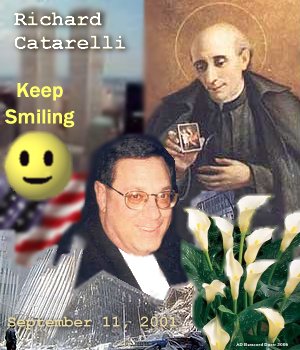
Richard G. Catarelli, employee of Marsh & McLennan, was a man of great faith and compassion. Prior to September 11th, 2001, he and his daughter Anamarie had just completed training to be youth ministers as a reflection of his devotion and dedication to the youth of the community. A cheerful and loving person, Richard's favorite line was "Keep Smiling" and his role model was the generous and energetic St. Vincent Pallotti.
Marsh and McLennan Companies has a very moving tribute page in his honor, with tributes from his wife and others close to him. It says more about this man than anything a random blogger like myself could ever say.
Other links about Richard:
http://www.september11victims.com/September11victims/VictimInfo.asp?ID=688
http://www.unitedinmemory.net/quilt.php?quilt=469
http://www.legacy.com/Guestbook.asp?PersonID=108361
Please read some of the other tributes written by the Bloggers for 2996.
(and if that isn't working, go here)

Wednesday, August 23, 2006
2,996: A Tribute to the Victims of 9/11
2,996 is a tribute to the victims of 9/11.
On September 11, 2006, 2,996 volunteer bloggers
will join together for a tribute to the victims of 9/11.
Each person will pay tribute to a single victim.
We will honor them by remembering their lives,
and not by remembering their murderers.
My person is Richard G. Catarelli, age 47.
Place killed: World Trade Center. Resident of New York, N.Y. (USA).
His tribute will be here on September 11, 2006.
If you have any questions about this project, you can probably find the answers here.
Friday, July 28, 2006

Friday, July 21, 2006
LJ Feed Button

I actually made this for another feed.
I've been balancing my information from Cedarseed and Israel North blog. I've been occassionally checking other sources, but these two have been the most useful.
Wednesday, July 05, 2006
Monday, June 26, 2006
The World eBook Fair
http://www.worldebookfair.com/
The World eBook Fair welcomes you to absolutely free access to a variety of eBook unparalleled by any other source. 1/3 million eBooks await you, all free of charge for the month from July 4 - August 4, 2006, and then 1/2 million eBooks in 2007, 3/4 million in 2008, and ONE million in 2009.
The World eBook Fair welcomes you to absolutely free access to a variety of eBook unparalleled by any other source. 1/3 million eBooks await you, all free of charge for the month from July 4 - August 4, 2006, and then 1/2 million eBooks in 2007, 3/4 million in 2008, and ONE million in 2009.
Friday, June 09, 2006
Some very informative sites
School Art Therapy
Excellent site for information on using art therapy in schools.
When Death Nears...
Pretty much the same information I have in my hospice volunteer documentation. At least in the pamphlet we give the families. I actually have more medical/technical handouts about it too.
Excellent site for information on using art therapy in schools.
When Death Nears...
Pretty much the same information I have in my hospice volunteer documentation. At least in the pamphlet we give the families. I actually have more medical/technical handouts about it too.
Tuesday, May 16, 2006
quick update
Finally walked for my BS in FSG last Saturday. Am still waiting to hear how much financial aide I will be getting for the art classes. Yes, I am going to get an associates in visual arts because it allows me to get funding and after I take all I need for my masters, I will have met the requirements anyway.
Saturday, April 29, 2006
A website I plan to revisit
Viktor Frankl Institute
Viktor E. Frankl, M.D., Ph.D.
Neurologist and psychiatrist
Founder of Logotherapy and Existential Analysis
During World War II he spent 3 years at Auschwitz, Dachau and other concentration camps.
(I've known about this guy since I was in high school. I just haven't studied him as much as I would like.)
Viktor E. Frankl, M.D., Ph.D.
Neurologist and psychiatrist
Founder of Logotherapy and Existential Analysis
During World War II he spent 3 years at Auschwitz, Dachau and other concentration camps.
(I've known about this guy since I was in high school. I just haven't studied him as much as I would like.)
Subscribe to:
Comments (Atom)