Tuesday, May 16, 2006
quick update
Finally walked for my BS in FSG last Saturday. Am still waiting to hear how much financial aide I will be getting for the art classes. Yes, I am going to get an associates in visual arts because it allows me to get funding and after I take all I need for my masters, I will have met the requirements anyway.


Saturday, April 29, 2006
A website I plan to revisit
Viktor Frankl Institute
Viktor E. Frankl, M.D., Ph.D.
Neurologist and psychiatrist
Founder of Logotherapy and Existential Analysis
During World War II he spent 3 years at Auschwitz, Dachau and other concentration camps.
(I've known about this guy since I was in high school. I just haven't studied him as much as I would like.)
Viktor E. Frankl, M.D., Ph.D.
Neurologist and psychiatrist
Founder of Logotherapy and Existential Analysis
During World War II he spent 3 years at Auschwitz, Dachau and other concentration camps.
(I've known about this guy since I was in high school. I just haven't studied him as much as I would like.)
Wednesday, March 29, 2006
Long time - no post
I hadn't realized it had been almost two months since my last post here. I apologize for the choppiness. I am very tired right now. Anyway, the state of my career/education at the moment.
Before I can apply for the masters program I want, I need to get some college level art classes. Most of my art knowledge was either received as a kid or self-taught. I will start at a community college this summer and if all goes well, I will have all my art credit done in two semesters.
In the meantime, I am working as a substitute teacher for the school district I live in. So far I've done Special Ed and elementary jobs. I actually like working with the special ed kids more. First off, they're not as sneaky. Second, the expectations are lower, so you can relax more and tend to their needs better. I took only a half day assignment today because I really am tired.
I am also a bereavement volunteer for a private hospice. I'm still in training for the volunteer program, but will be doing a regular volunteer assignment on Friday, since they were short people. I have completed the normal volunteer training and now need to schedule the bereavement training. I will be doing things like attending wakes, funerals, and memorials, as well as help plan them in some instances. But for the most part, I will just be checking in on survivors and just listening to them.
Before I can apply for the masters program I want, I need to get some college level art classes. Most of my art knowledge was either received as a kid or self-taught. I will start at a community college this summer and if all goes well, I will have all my art credit done in two semesters.
In the meantime, I am working as a substitute teacher for the school district I live in. So far I've done Special Ed and elementary jobs. I actually like working with the special ed kids more. First off, they're not as sneaky. Second, the expectations are lower, so you can relax more and tend to their needs better. I took only a half day assignment today because I really am tired.
I am also a bereavement volunteer for a private hospice. I'm still in training for the volunteer program, but will be doing a regular volunteer assignment on Friday, since they were short people. I have completed the normal volunteer training and now need to schedule the bereavement training. I will be doing things like attending wakes, funerals, and memorials, as well as help plan them in some instances. But for the most part, I will just be checking in on survivors and just listening to them.
Tuesday, January 24, 2006
She sings!

I was in a weird mood. I was going to sing "Catch a Falling Star", but then my throat began to constrict on me, so instead I sung this song from my childhood. I went ahead and posted it without listening to it, because I probably would have chickened out and deleted it otherwise.
Tuesday, January 17, 2006
Would you pass?
The Bathtub Test
It doesn't hurt to take a hard look at yourself from time to time, and this should help get you started.
During a visit to a mental asylum, a visitor asked the Director what the criterion was that defined whether or not a patient should be institutionalized.
"Well," said the Director, "we fill up a bathtub; then we offer a teaspoon, a teacup and a bucket to the patient and ask him or her to empty the bathtub."
"Oh, I understand," said the visitor. "A normal person would use the bucket because it's bigger than the spoon or the teacup.
"No," said the Director, "A normal person would pull the plug. Do you want a bed by the wall or near the window?"
It doesn't hurt to take a hard look at yourself from time to time, and this should help get you started.
During a visit to a mental asylum, a visitor asked the Director what the criterion was that defined whether or not a patient should be institutionalized.
"Well," said the Director, "we fill up a bathtub; then we offer a teaspoon, a teacup and a bucket to the patient and ask him or her to empty the bathtub."
"Oh, I understand," said the visitor. "A normal person would use the bucket because it's bigger than the spoon or the teacup.
"No," said the Director, "A normal person would pull the plug. Do you want a bed by the wall or near the window?"
Finally!


It was great last night! The first person I saw was my friend, the staff member who auditted the Intro to Counseling class with my first group and was my partner for an oral presentation on Art Therapy. She was conducting an information meeting for prospective students and was standing in the hall when I walked into the building. She told me I looked so much better and I told her it was my last night. She of course had to tell me how proud and happy she was for me.
In class, our program director spoke with us and gave us our final paperwork and presented us with balloon and tag to write our griefs on one side and our dreams on the other side to release into the sky after class. I really needed that. When TF left my first group, I lost the only person I had really bonded with and spent the rest of the time feeling sort of like a pariah. I'm glad now that I did get to finish with another group. They've been great people and we're having an ice cream sundae party next Monday at the house of the woman who gave me rides to class when I didn't have a working car.
Before we did our final presentations, we got our food - BBQ brisket from the same place the kids and I went with CK last Firday - yum! And I got a piece of German chocolate cake. I passed around my ATCs for trade, including some I haven't offered online yet. Someone else gave all of us a big chocolate kiss.
We gave the presentations without a break. Then our prof congratulated us. She left before we could get her to take a class picture. We got another prof who was teaching down the hall to do it. She was tickled, because she teaches like the fourth module and she doesn't usually get to see a group at the end. I was the one who wrote our group designation and year for our class to pose in front of. The prof who took our picture was one of my favorites. After we did our picture, we all went out into the parking lot and released our balloons together.
As I left the campus, my car radio was playing "Time of Your Life" by Green Day.
"Good Riddance (Time Of Your Life)"
Another turning point, a fork stuck in the road
Time grabs you by the wrist, directs you where to go
So make the best of this test, and don't ask why
It's not a question, but a lesson learned in time
It's something unpredictable, but in the end it's right.
I hope you had the time of your life.
So take the photographs, and still frames in your mind
Hang it on a shelf in good health and good time
Tattoos of memories and dead skin on trial
For what it's worth it was worth all the while
It's something unpredictable, but in the end it's right.
I hope you had the time of your life.
It's something unpredictable, but in the end it's right.
I hope you had the time of your life.
It's something unpredictable, but in the end it's right.
I hope you had the time of your life.
Now, I have 15 credit hours of art to take before I can go for my masters in Art Therapy.
Friday, December 23, 2005
cross-posted from my personal journal
Dr. Helen: Excuse Me While I go Throw Up
Which brings me back to blogging. There is something refreshing about the ability to post one's thoughts and tout one's wares (such as documentary films, books etc.) over the internet while barely being able to hold a fork to one's mouth before rushing to the bathroom to throw up from some stomach bug you picked up from your kid's school a few days before. I wonder how many other bloggers are out there posting on a regular basis and keeping the world amused because it is one of the few outlets that requires little physical exertion? I could be wrong but it seems to me that if one is vibrant with good health and stamina, they would be out snowboading, skiing or just enjoying the outdoors. I know I would. Anyone else out there blog to distract yourself from feeling bad--whether physical or mental? It would be nice to know I had some company.
Amen, sister.
Seriously, it's the only thing sometimes that keeps me from curling up into a ball and giving up on everything. My dad likes to believe that if I cut back on connecting to people on the Internet that I will suddenly get better and get tons of stuff done. He tried to force his will on this matter when the kids and I still lived with them and you know what - never happened. I will go and do a few things and then I will curl up into bed and not move because I am in so much pain.
Right now, my lower back is pulsating and my head hurts. I did some cleaning in the kitchen and I'm typing up a few things while everything subsides enough to let me do more. If I wasn't sitting here reading other people's stuff, IMing a friend and typing this post, I would be back in bed, losing all track of time, with nothing to show for it.
Yes, my hands are tingling too and my arms are achy, but compare to the back at the moment, those are no big deal. That's the fun part of fibromyalgia - you're almost always in pain, so you kind of learn to ignore some of it. You can't totally ignore it, because it gets you back. Usually by denying you the ability to use your muscles. I sometimes have to curl up and not do anything because I lose my coordination.
To put it all into perspective. I get my B12 shots in the upper arm. I can feel the needle enter my skin and I never flinch. Compared to everything else, it's hardly worth noticing.
Which brings me back to blogging. There is something refreshing about the ability to post one's thoughts and tout one's wares (such as documentary films, books etc.) over the internet while barely being able to hold a fork to one's mouth before rushing to the bathroom to throw up from some stomach bug you picked up from your kid's school a few days before. I wonder how many other bloggers are out there posting on a regular basis and keeping the world amused because it is one of the few outlets that requires little physical exertion? I could be wrong but it seems to me that if one is vibrant with good health and stamina, they would be out snowboading, skiing or just enjoying the outdoors. I know I would. Anyone else out there blog to distract yourself from feeling bad--whether physical or mental? It would be nice to know I had some company.
Amen, sister.
Seriously, it's the only thing sometimes that keeps me from curling up into a ball and giving up on everything. My dad likes to believe that if I cut back on connecting to people on the Internet that I will suddenly get better and get tons of stuff done. He tried to force his will on this matter when the kids and I still lived with them and you know what - never happened. I will go and do a few things and then I will curl up into bed and not move because I am in so much pain.
Right now, my lower back is pulsating and my head hurts. I did some cleaning in the kitchen and I'm typing up a few things while everything subsides enough to let me do more. If I wasn't sitting here reading other people's stuff, IMing a friend and typing this post, I would be back in bed, losing all track of time, with nothing to show for it.
Yes, my hands are tingling too and my arms are achy, but compare to the back at the moment, those are no big deal. That's the fun part of fibromyalgia - you're almost always in pain, so you kind of learn to ignore some of it. You can't totally ignore it, because it gets you back. Usually by denying you the ability to use your muscles. I sometimes have to curl up and not do anything because I lose my coordination.
To put it all into perspective. I get my B12 shots in the upper arm. I can feel the needle enter my skin and I never flinch. Compared to everything else, it's hardly worth noticing.
Monday, December 12, 2005
FROGS!

I had to join.
You see, when I was barely 18 months old, my mother found a dried-out tree frog in my mouth and freaked. And since that day, I have been connected with frogs in my family. I even had a six-foot long stuffed frog as a kid. I was always receiving frog stuff as a kid, thereby assuring that I would be scarred for the rest of my life for an action I have no memory of, nor could possibly hope to remember.
Now, I shall have my vengence!
Wednesday, December 07, 2005
Six Core Elements of Character
What do you know? Someone figured this out a long time ago and the following are considered to be universal:
- Trustworthiness
- Respect
- Responsibility (self-discipline)
- Fairness
- Caring (compassion)
- Citizenship (obeying the law, staying informed of current affairs, voting, etc.)
Aristotle's Four Classic Values
- Fortitude (perserverance)
- Temperance (controlling human passions)
- Prudence (practical wisdom)
- Justice (fairness, lawfulness)
The Catholic Church later added Faith, Hope, and Charity.
Death of a Salesman Summary
Willie Loman based his most of his life on lies. The saddest part is that he actually made the lie that "all you need to succeed is to be liked" part of his core belief system. It appeared to be the only thing he really did believe and all his efforts went to presenting an image he thought other people would like and admire. He even lied regularly to keep his mental world intact.
So strong was this need to be popular and liked, that he broke commitments and promises to gain immediate ego boosts from whoever he was with. He behaved in some ways like an narcissistic personality disorder in that his focus was gaining admiration and maintaining an image of himself that he was in love with and he was willing to protect that image at all costs, even though there was evidence that most people didn't believe in it. His image of the charismatic and successful salesman only hid his insecurities and failings. Deep inside, he knew he wasn't that, but the fear of facing his true self was so great that he couldn't stand to see anything that disproved that image.
Unfortunately, by following a faulty premise, he blinded himself to reality and it caught up to him. It caught up to him as a parent, when the son he put all his dreams on lacked the discipline to even hold down a steady job, because he treated the oldest son as an extension on himself and couldn't stand to be firm with him as a child. He also alienated his eldest son by having an affair, which shattered his son's image of him and led to a desire to hurt his father by not going to college and becoming a football star. Willie's behavior also affected his other son, who in a desperate attempt to get his father's regard, modelled himself after his father's idea of how to succeed and was showing the same lack of results.
It caught up to him as a worker, when he slowly made himself a failure by not paying attention to his mistakes and faulty premises so he could correct them and be effective in his job. He made himself unemployable and because successful businessmen didn't take meager jobs, he refused the only real chance he had of rebuilding his career.
It caught up with him as a person, when he found himself facing truths he didn't have the strength of character to withstand. His only path was suicide and in his death we find that his beliefs failed him so thoroughly that when it was all said in done, the only people who grieved for him was his family and two neighbors who pitied him. The man who spent all his time trying to be liked in the end wasn't liked by anyone.
The only person Willie seemed to not have offended was his wife Linda, who was willing for whatever reason to believe his lies and support his dreams. If she knew about his infidelity, she never let it affect her publicly. She was so emotionally enmeshed with Willie that she never really asked herself if his core beliefs held water. To Willie's credit, he did recognize how important his wife's support was to him, something a true narcissistic personality disorder probably would never admit to himself.
While it is easy to see why Willie chose to value some of the things he did, it's hard to understand why he didn't see his own failure sooner. We all have believed inaccurate "rules" in our lives, yet most of us would re-examine our beliefs when there is evidence that we were in trouble. Wille doesn't do this. He ended his life instead. But he did his best to end in way that it would give his family some benefit. He was still trying to provide for them. For all his failings, he did love his family.
So strong was this need to be popular and liked, that he broke commitments and promises to gain immediate ego boosts from whoever he was with. He behaved in some ways like an narcissistic personality disorder in that his focus was gaining admiration and maintaining an image of himself that he was in love with and he was willing to protect that image at all costs, even though there was evidence that most people didn't believe in it. His image of the charismatic and successful salesman only hid his insecurities and failings. Deep inside, he knew he wasn't that, but the fear of facing his true self was so great that he couldn't stand to see anything that disproved that image.
Unfortunately, by following a faulty premise, he blinded himself to reality and it caught up to him. It caught up to him as a parent, when the son he put all his dreams on lacked the discipline to even hold down a steady job, because he treated the oldest son as an extension on himself and couldn't stand to be firm with him as a child. He also alienated his eldest son by having an affair, which shattered his son's image of him and led to a desire to hurt his father by not going to college and becoming a football star. Willie's behavior also affected his other son, who in a desperate attempt to get his father's regard, modelled himself after his father's idea of how to succeed and was showing the same lack of results.
It caught up to him as a worker, when he slowly made himself a failure by not paying attention to his mistakes and faulty premises so he could correct them and be effective in his job. He made himself unemployable and because successful businessmen didn't take meager jobs, he refused the only real chance he had of rebuilding his career.
It caught up with him as a person, when he found himself facing truths he didn't have the strength of character to withstand. His only path was suicide and in his death we find that his beliefs failed him so thoroughly that when it was all said in done, the only people who grieved for him was his family and two neighbors who pitied him. The man who spent all his time trying to be liked in the end wasn't liked by anyone.
The only person Willie seemed to not have offended was his wife Linda, who was willing for whatever reason to believe his lies and support his dreams. If she knew about his infidelity, she never let it affect her publicly. She was so emotionally enmeshed with Willie that she never really asked herself if his core beliefs held water. To Willie's credit, he did recognize how important his wife's support was to him, something a true narcissistic personality disorder probably would never admit to himself.
While it is easy to see why Willie chose to value some of the things he did, it's hard to understand why he didn't see his own failure sooner. We all have believed inaccurate "rules" in our lives, yet most of us would re-examine our beliefs when there is evidence that we were in trouble. Wille doesn't do this. He ended his life instead. But he did his best to end in way that it would give his family some benefit. He was still trying to provide for them. For all his failings, he did love his family.
Saturday, December 03, 2005
Last module
Some of the discussion questions I did for homework.
Think of how your parents and grandparents view God's relationship with man. Can you see any parallel between that and how they relate to other people? If they don't believe in a Creator, then use their idea of the relationship between natural law and the individual and compare it to how they relate to other people.
I once did an exercise where I was to write down and compare the beliefs of God that my ancestors had to what I believed. After I wrote them down, I realized that the beliefs I recognized in them mirrored how I saw them treat others. Over the years, I've noticed that many people showed this mirroring. A person who believes that God blesses some people more than others for reasons other than earning those blessings, often will play favorites herself. A person who believes that God is harsh and unyielding will treat people the same way. Someone who believes that natural law is where organisms only does what profits them, will only interact with those who are benefit to them. While those who believe that natural law includes supporting the community will seek for more communal integration.
Should character-based instruction be reintroduced to the public schools? Can it be reintroduced after being removed for decades? Can there be agreement as to what is good character among those of differing beliefs?
In an ideal world, character-based instruction would be introduced. However, as things stand, I don't think it will happen just because many people have no idea what character really is and confuse it with beliefs. These people will oppose the introduction of character-based instruction on principle alone. I do believe that if society crumbles enough that character-based instruction could be introduced, but I'm not happy that it would have to take our world coming to the brink of disaster to convince people to do this. I think if we keep it simple, agreement as to what makes up good character can be found in the values similar to all stable cultures.
Is it possible to reach a point where no one is critical of you?
I personally think this is an impossible pipe dream, but I know several people who believe it with all their hearts. They refuse to accept the concept of making peace with the idea that there will always be someone who is willing to tell you you're worthless because of personal agendas or mismatched values systems.
Think of how your parents and grandparents view God's relationship with man. Can you see any parallel between that and how they relate to other people? If they don't believe in a Creator, then use their idea of the relationship between natural law and the individual and compare it to how they relate to other people.
I once did an exercise where I was to write down and compare the beliefs of God that my ancestors had to what I believed. After I wrote them down, I realized that the beliefs I recognized in them mirrored how I saw them treat others. Over the years, I've noticed that many people showed this mirroring. A person who believes that God blesses some people more than others for reasons other than earning those blessings, often will play favorites herself. A person who believes that God is harsh and unyielding will treat people the same way. Someone who believes that natural law is where organisms only does what profits them, will only interact with those who are benefit to them. While those who believe that natural law includes supporting the community will seek for more communal integration.
Should character-based instruction be reintroduced to the public schools? Can it be reintroduced after being removed for decades? Can there be agreement as to what is good character among those of differing beliefs?
In an ideal world, character-based instruction would be introduced. However, as things stand, I don't think it will happen just because many people have no idea what character really is and confuse it with beliefs. These people will oppose the introduction of character-based instruction on principle alone. I do believe that if society crumbles enough that character-based instruction could be introduced, but I'm not happy that it would have to take our world coming to the brink of disaster to convince people to do this. I think if we keep it simple, agreement as to what makes up good character can be found in the values similar to all stable cultures.
Is it possible to reach a point where no one is critical of you?
I personally think this is an impossible pipe dream, but I know several people who believe it with all their hearts. They refuse to accept the concept of making peace with the idea that there will always be someone who is willing to tell you you're worthless because of personal agendas or mismatched values systems.
Tuesday, November 22, 2005
some news articles of child neglect and abuse
Orphaned Babies Show Hormone Disruption Years after Adoption
Orphans have a hard lot in life, particularly in Eastern Europe, where state institutions sometimes provide care that has been reduced to simple feeding and changing with a minimum of physical contact. That neglect--even without any other abuse--can take a profound emotional and physical toll, potentially deeply affecting a child's neurobiology. New research shows that children adopted from such institutions who have spent as many as three years in their new homes still suffer from depressed levels of hormones that have been linked to bonding, caring, communicating and stress regulation, among other things.
Scars That Won't Heal: The Neurobiology of Child Abuse
In 1994 Boston police were shocked to discover a malnourished four-year-old locked away in a filthy Roxbury apartment, where he lived in dreadfully squalid conditions. Worse, the boy's tiny hands were found to have been horrendously burned. It emerged that his drug-abusing mother had held the child's hands under a steaming-hot faucet to punish him for eating her boyfriend's food, despite her instructions not to do so. The ailing youngster had been given no medical care at all. The disturbing story quickly made national headlines. Later placed in foster care, the boy received skin grafts to help his scarred hands regain their function. But even though the victim's physical wounds were treated, recent research findings indicate that any injuries inflicted to his developing mind may never truly heal.
Though an extreme example, the notorious case is unfortunately not all that uncommon. Every year child welfare agencies in the U.S. receive more than three million allegations of childhood abuse and neglect and collect sufficient evidence to substantiate more than a million instances.
You have to pay to read the last article. I'm just linking to it so if I do a paper later on the subject, I know what keywords to use in the scholarly journal databases for the actual studies.
Orphans have a hard lot in life, particularly in Eastern Europe, where state institutions sometimes provide care that has been reduced to simple feeding and changing with a minimum of physical contact. That neglect--even without any other abuse--can take a profound emotional and physical toll, potentially deeply affecting a child's neurobiology. New research shows that children adopted from such institutions who have spent as many as three years in their new homes still suffer from depressed levels of hormones that have been linked to bonding, caring, communicating and stress regulation, among other things.
Scars That Won't Heal: The Neurobiology of Child Abuse
In 1994 Boston police were shocked to discover a malnourished four-year-old locked away in a filthy Roxbury apartment, where he lived in dreadfully squalid conditions. Worse, the boy's tiny hands were found to have been horrendously burned. It emerged that his drug-abusing mother had held the child's hands under a steaming-hot faucet to punish him for eating her boyfriend's food, despite her instructions not to do so. The ailing youngster had been given no medical care at all. The disturbing story quickly made national headlines. Later placed in foster care, the boy received skin grafts to help his scarred hands regain their function. But even though the victim's physical wounds were treated, recent research findings indicate that any injuries inflicted to his developing mind may never truly heal.
Though an extreme example, the notorious case is unfortunately not all that uncommon. Every year child welfare agencies in the U.S. receive more than three million allegations of childhood abuse and neglect and collect sufficient evidence to substantiate more than a million instances.
You have to pay to read the last article. I'm just linking to it so if I do a paper later on the subject, I know what keywords to use in the scholarly journal databases for the actual studies.
Wednesday, November 16, 2005

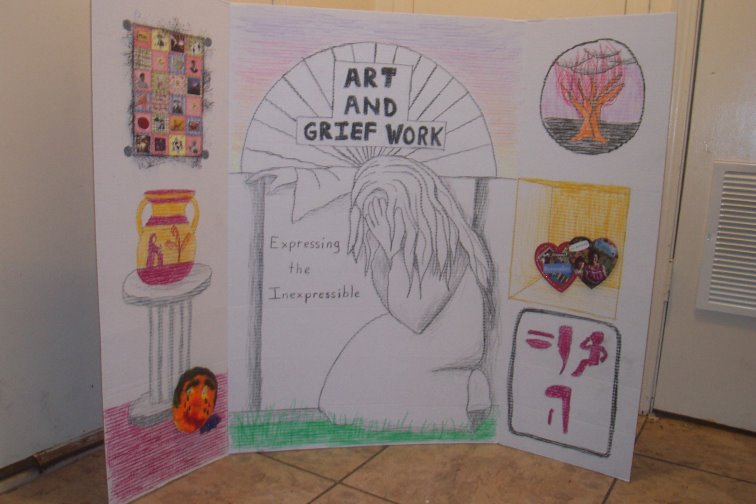
Factsheet for my oral report next week
Expressing the Inexpressible
Art in Grief Work - Fact Sheet
Art has been an integral part of grief work since the dawn of time.
“(A)rt forms have been a part of funeral ceremonies since Neanderthal times.“ - Malchiodi, C. (1998). The Art Therapy Sourcebook. (p. 142)
During the Black Plague, art took on a more morbid air, reflecting the fear, anger and sorrow which was universally felt. “Marked by crowded, paranoid compositions, ugly, menacing faces, bright colors and increased violence, Black Death art is unbalanced and uneasy.“ - Art and Death (http://death.monstrous.com/art_and_death.htm)
In the 19th century, posthumous mourning portraiture and other art became part of the morning process. - Leming, M. & Dickinson, G. (2002). Understanding Dying, Death, and Bereavement. (p 406).
Private bereavement art can take other forms besides drawing and painting.
Masks - Masks can represent “faces” of ourselves. (Allen, P. [1995]. Art is a Way of Knowing. p 81-82, 113-114) Similar to some primitive cultures, making masks of deceased loved ones helps to deal with the grief. (Allen, 127-140) Masks can also help resolve issues with long deceased relatives. (Allen, p165-167)
Collages - Using images from family photos, magazines and other sources can help a client connect and/or explore their personal history and the connections with family and society. (Allen, p 144-145)
Mandalas - Creating circular drawings helps to symbolize “wholeness” or the intention to be whole. It is often a very calming task. (Allen, p. 192) Releases tension and gives a holistic way to examine inner conflicts using Jungian principles. (Fincher, S. [1991]. Creating Mandalas - For Insight, Healing and Self-Expression. p. 24-32) Also allows the client to focus themselves mentally. (Fincher, p. 175)
Heart-shaped Memory Boxes - Heart-shaped boxes decorated usually decorated in collage-style. Allows the client to represent their public and private relationship with the deceased. (Primetime Live, March 7, 2002. “Tender Hearts - Art Helps Children of 9/11 Heal”.)
Quilts make a good community grief project, as in the AIDS Memorial Quilt. (Malchiodi, p 142-143)
Art Therapy is especially effective in grief work.
Perceived as less threatening than many traditional interventions. (Kahn, B. [1999]. “Art therapy with adolescents: Making it work for school counselors.“ ¶ 2)
It's flexible enough to be used with more than one approach and can be very client-centered, giving a safe outlet for disturbing themes. (Kahn, ¶ 5)
“(A)rt seems to appear spontaneously when confronted with a significant loss...“ (Malchiodi, p 144)
Art can be particularly helpful to those whose trauma is so severe that they can't find words for it. (Malchiodi, p 149)
“Color unlocks emotion...” (Fincher, p 172)
Damaging a piece of one's own artwork is an act of damaging the self, without actually harming the artist physically. It is a better release for self-directed anger. (Fincher, p 174)
Art in Grief Work - Fact Sheet
Art has been an integral part of grief work since the dawn of time.
“(A)rt forms have been a part of funeral ceremonies since Neanderthal times.“ - Malchiodi, C. (1998). The Art Therapy Sourcebook. (p. 142)
During the Black Plague, art took on a more morbid air, reflecting the fear, anger and sorrow which was universally felt. “Marked by crowded, paranoid compositions, ugly, menacing faces, bright colors and increased violence, Black Death art is unbalanced and uneasy.“ - Art and Death (http://death.monstrous.com/art_and_death.htm)
In the 19th century, posthumous mourning portraiture and other art became part of the morning process. - Leming, M. & Dickinson, G. (2002). Understanding Dying, Death, and Bereavement. (p 406).
Private bereavement art can take other forms besides drawing and painting.
Masks - Masks can represent “faces” of ourselves. (Allen, P. [1995]. Art is a Way of Knowing. p 81-82, 113-114) Similar to some primitive cultures, making masks of deceased loved ones helps to deal with the grief. (Allen, 127-140) Masks can also help resolve issues with long deceased relatives. (Allen, p165-167)
Collages - Using images from family photos, magazines and other sources can help a client connect and/or explore their personal history and the connections with family and society. (Allen, p 144-145)
Mandalas - Creating circular drawings helps to symbolize “wholeness” or the intention to be whole. It is often a very calming task. (Allen, p. 192) Releases tension and gives a holistic way to examine inner conflicts using Jungian principles. (Fincher, S. [1991]. Creating Mandalas - For Insight, Healing and Self-Expression. p. 24-32) Also allows the client to focus themselves mentally. (Fincher, p. 175)
Heart-shaped Memory Boxes - Heart-shaped boxes decorated usually decorated in collage-style. Allows the client to represent their public and private relationship with the deceased. (Primetime Live, March 7, 2002. “Tender Hearts - Art Helps Children of 9/11 Heal”.)
Quilts make a good community grief project, as in the AIDS Memorial Quilt. (Malchiodi, p 142-143)
Art Therapy is especially effective in grief work.
Perceived as less threatening than many traditional interventions. (Kahn, B. [1999]. “Art therapy with adolescents: Making it work for school counselors.“ ¶ 2)
It's flexible enough to be used with more than one approach and can be very client-centered, giving a safe outlet for disturbing themes. (Kahn, ¶ 5)
“(A)rt seems to appear spontaneously when confronted with a significant loss...“ (Malchiodi, p 144)
Art can be particularly helpful to those whose trauma is so severe that they can't find words for it. (Malchiodi, p 149)
“Color unlocks emotion...” (Fincher, p 172)
Damaging a piece of one's own artwork is an act of damaging the self, without actually harming the artist physically. It is a better release for self-directed anger. (Fincher, p 174)
A puzzling piece of art
Elonka's Kryptos Page
Kryptos is a sculpture located on the grounds of CIA Headquarters in Langley, Virginia. Installed in 1990, its thousands of characters contain encrypted messages, of which three have been solved (so far). There is still a fourth section at the bottom consisting of 97 or 98 characters which remains uncracked. This webpage contains some information about the sculpture, including some photos collected from around the web, some rubbings of the sculpture taken by your intrepid webmistress, links to other articles and Kryptos discussion groups here and there, and information about other encrypted sculptures which have been created by the sculptor, James Sanborn.
Kryptos is a sculpture located on the grounds of CIA Headquarters in Langley, Virginia. Installed in 1990, its thousands of characters contain encrypted messages, of which three have been solved (so far). There is still a fourth section at the bottom consisting of 97 or 98 characters which remains uncracked. This webpage contains some information about the sculpture, including some photos collected from around the web, some rubbings of the sculpture taken by your intrepid webmistress, links to other articles and Kryptos discussion groups here and there, and information about other encrypted sculptures which have been created by the sculptor, James Sanborn.
Monday, November 14, 2005
Chapter Eleven Short Essay - The Business of Dying
Before the Victorian age, funerals were times of public mourning and long sermons in most of the United States. Most people were buried wherever it was convenient. The Puritans eschewed the displays of grief and buried the dead near churches, but still gave elegies and long sermons on the fate of the living, because in their minds the dead had already had their fate sealed.
With the introduction of industrialization, the need for a third party to handle funerals and burial became great enough that people began to make a living taking care of dead. But while industrialization created a livelihood, the funeral industry made sure they shaped public expectations to make work easier for them, by convincing people to focus more on comforting the survivors than facing the death and loss. Funeral directors talked the clergy into giving shorter and more uplifting sermons. They began removing the morbid and scary images from monuments and memorials. They beautified and preserved the corpse to give them a more peaceful look. They substituted the ominous coffin for the stately casket and decorated the interior to look like a bed. In short, they worked to make it more pleasant to have a “professional” do the funeral, than to adhere to older traditions.
Even in the twentieth century, funeral homes and cemeteries influenced burial traditions. The introduction of “lawn cemeteries” appeared. While they may argue that this is a far more peaceful atmosphere for grieving people, the ease of caring for a lawn cemetery is obviously a savings for whomever maintains them. As is the push to standardize grave markers and minimalize the amount of personalization of them. While the industry calls it aesthetics and making it more economical for the consumer, there is no doubt the main beneficiary is the industry itself.
With the introduction of industrialization, the need for a third party to handle funerals and burial became great enough that people began to make a living taking care of dead. But while industrialization created a livelihood, the funeral industry made sure they shaped public expectations to make work easier for them, by convincing people to focus more on comforting the survivors than facing the death and loss. Funeral directors talked the clergy into giving shorter and more uplifting sermons. They began removing the morbid and scary images from monuments and memorials. They beautified and preserved the corpse to give them a more peaceful look. They substituted the ominous coffin for the stately casket and decorated the interior to look like a bed. In short, they worked to make it more pleasant to have a “professional” do the funeral, than to adhere to older traditions.
Even in the twentieth century, funeral homes and cemeteries influenced burial traditions. The introduction of “lawn cemeteries” appeared. While they may argue that this is a far more peaceful atmosphere for grieving people, the ease of caring for a lawn cemetery is obviously a savings for whomever maintains them. As is the push to standardize grave markers and minimalize the amount of personalization of them. While the industry calls it aesthetics and making it more economical for the consumer, there is no doubt the main beneficiary is the industry itself.
Sunday, November 13, 2005
Chapter Ten Short Essay - Death Rituals
As varied as death rituals are around the world, like other rites of passage, they all consist of three parts. The first is the separation of the bereaved from the non-bereaved. In most cultures, this is not actually a physical separation as it is identifying the affected people through marking them as mourners. This can be accomplished through a change of clothing and adornment and/or actions that are not commonly used during normal life. Sometimes the bereaved do separate themselves physically from others to be alone with their grief. They withdraw themselves from work and other social activities. Depending on the culture, the mourners can be extremely quiet and stoic about their loss or everyone may take the opportunity to wail and release their sorrow in a physically intense manner. In general, women are expected to take longer at this than men. Many cultures allow men to remarry sooner than women after the death of a spouse without social reprisals.
The second part is the transition from being a part of the society to being accepted as dead. With some cultures this is a relatively short part, taking only as long as it does to bury the body (or send it to professionals to do it) and getting the paperwork done to take care of the estate and notify the government. In other cultures, it can take up to three years and even a few reburials.
Once the deceased has been ritualistically declared no longer a living part of society, the reintegration of the mourners into society occurs. This is done usually through a large meal or party, where people can begin to shed their more visible mourning behavior and return to a normal daily routine.
The second part is the transition from being a part of the society to being accepted as dead. With some cultures this is a relatively short part, taking only as long as it does to bury the body (or send it to professionals to do it) and getting the paperwork done to take care of the estate and notify the government. In other cultures, it can take up to three years and even a few reburials.
Once the deceased has been ritualistically declared no longer a living part of society, the reintegration of the mourners into society occurs. This is done usually through a large meal or party, where people can begin to shed their more visible mourning behavior and return to a normal daily routine.
Chapter Nine Short Essay - Suicide
In general, suicides occur in the context of social connectivity. The people most likely to commit suicide either have too few social ties (troubled adolescents) or too many (high stressed occupations). Changes in social ties like deaths, divorces, unemployment, retirement and relocation, also increases the likelihood of suicide.
Child suicides are more prevalent in homes where family ties are disrupted and/or other members have committed suicide. Adolescent suicides have the same risk factors as child ones, with the extra dimension of poor peer relations. Adolescents are also more likely to commit copycat suicides. Adult suicides are more influenced by personal losses, though parents are less likely to commit suicide than non-parents.
Elderly suicide is most likely to be a rational suicide where the older person decides to end their life in an effort to make life easier for those around them. Another cause of elderly suicide is an inability to adjust to retirement or widowhood. While other age groups are prone to suicide gestures, the elderly are far more likely to be successful with their suicides. They approach suicide with a great deal of forethought and planning. In most cases, they give no warning to their friends and family. However, they usually make sure that their other affairs are in order and try to leave a minimal amount of mess to clean up.
Social driven suicides, or honorable suicides, only occur in cultures where they are accepted. Even in some cultures that abhor suicides, certain reasons for killing one's self are considered acceptable if they are done to support a higher moral principle. Some cultures will change their acceptance of suicides when it begins to impact society.
Child suicides are more prevalent in homes where family ties are disrupted and/or other members have committed suicide. Adolescent suicides have the same risk factors as child ones, with the extra dimension of poor peer relations. Adolescents are also more likely to commit copycat suicides. Adult suicides are more influenced by personal losses, though parents are less likely to commit suicide than non-parents.
Elderly suicide is most likely to be a rational suicide where the older person decides to end their life in an effort to make life easier for those around them. Another cause of elderly suicide is an inability to adjust to retirement or widowhood. While other age groups are prone to suicide gestures, the elderly are far more likely to be successful with their suicides. They approach suicide with a great deal of forethought and planning. In most cases, they give no warning to their friends and family. However, they usually make sure that their other affairs are in order and try to leave a minimal amount of mess to clean up.
Social driven suicides, or honorable suicides, only occur in cultures where they are accepted. Even in some cultures that abhor suicides, certain reasons for killing one's self are considered acceptable if they are done to support a higher moral principle. Some cultures will change their acceptance of suicides when it begins to impact society.
Subscribe to:
Posts (Atom)